Why Teams Are Looking Beyond Demostack
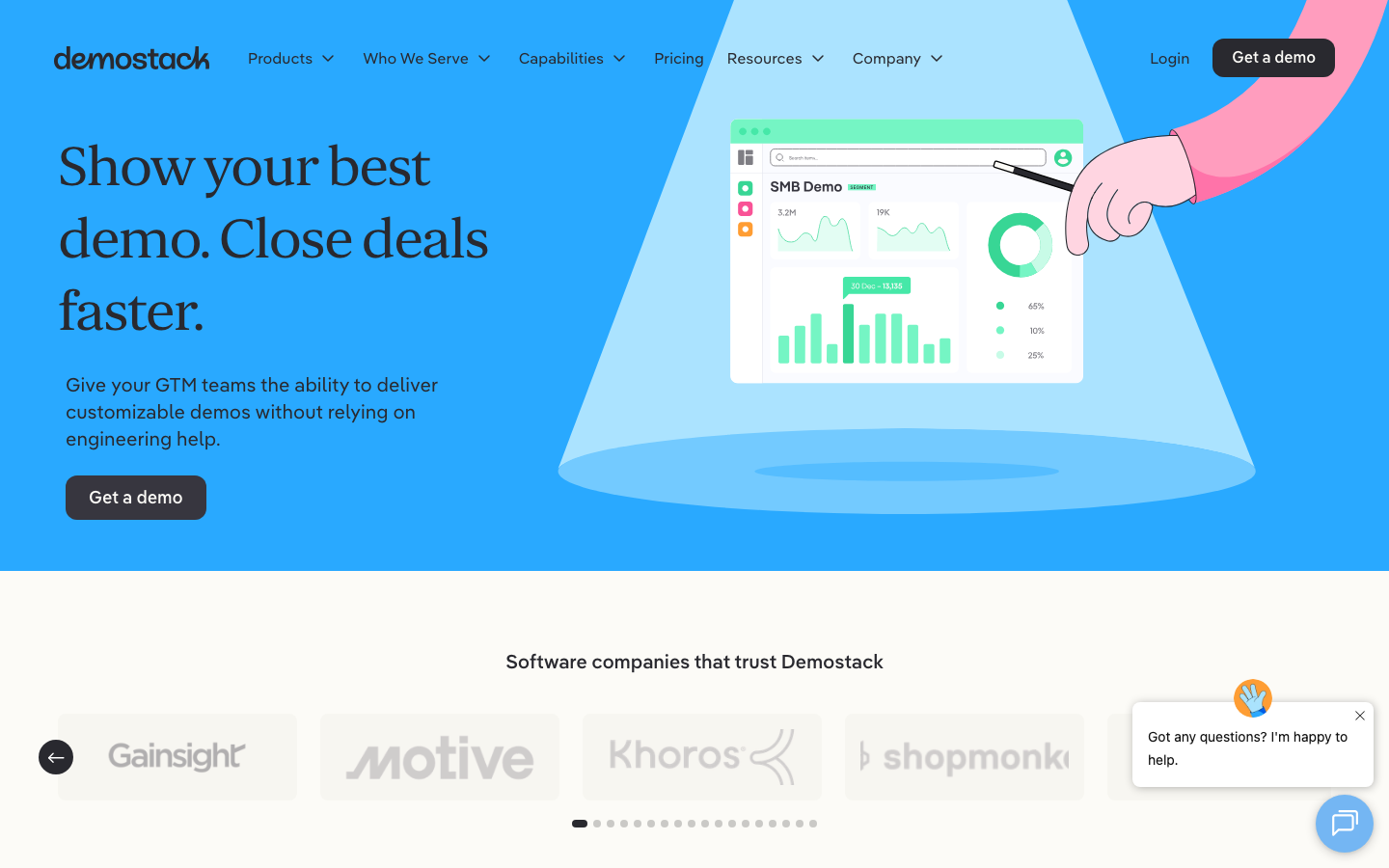
Demostack pioneered the concept of demo environment cloning. The idea is compelling: take your live product, create a "digital twin" of the front end, and let sales reps give fully interactive demos with personalised data, custom branding, and no risk of breaking anything. With $51.5M in funding from Tiger Global and Bessemer Venture Partners, Demostack built serious technology for enterprise B2B sales teams.
But at $25,000 to $55,000+ per year (with an average contract around $32,000 via Vendr), many teams find the price impossible to justify. There is no free tier. There is no trial. You cannot sign up and evaluate the product yourself. You contact sales, negotiate a contract, and commit to an annual deal before you see Demostack working with your product. For a tool category where alternatives start at $40/mo with a free trial, this friction is significant.
Beyond pricing, Demostack requires engineering involvement for the initial cloning setup, needs frequent rebuilds when your product UI changes, and does not produce video output at all. The output is an interactive HTML environment, not an MP4 you can upload to YouTube or drop into a sales deck. Teams searching for alternatives typically want one or more of these things: lower cost, video output, faster setup, or less maintenance.
This guide gives Demostack fair credit for what it does well, explains where it falls short, and walks through the best alternatives for teams that need polished demo content without the enterprise price tag or engineering overhead.
What Demostack Does Well
Demostack is not overpriced for what it delivers. It is a genuine enterprise platform built for a specific sales motion. Before discussing alternatives, it is worth understanding what Demostack actually does and who it serves well.
HTML Cloning and Digital Twins
Demostack's core technology creates full front-end replicas of your product. These are not screenshots or screen recordings. They are functional HTML environments that look and behave like your actual product. Dropdowns open. Forms accept input. Navigation works. For a prospect sitting in a live demo, the experience is nearly indistinguishable from the real product.
This is genuinely impressive engineering. The cloning captures your application's front-end code and creates a sandboxed version that sales reps can demonstrate without affecting production data or systems. For enterprise sales teams running live demos for buying committees, this level of realism matters.
Sandbox Environments
Each cloned environment is a sandbox. Sales reps can click through any workflow, fill in forms, trigger interactions, and show the product in action without worrying about breaking anything. If a rep makes a mistake during a demo, they reset the sandbox and start again. No production data is at risk.
For high-stakes enterprise sales calls where a product crash during a demo can lose a six-figure deal, sandboxed environments provide real peace of mind.
AI Personalisation
Demostack lets sales reps swap logos, company names, data sets, and feature visibility per demo. If you are demoing to Acme Corp, you can show the product with Acme's logo, relevant industry data, and only the features that matter to their use case. This personalisation happens through a no-code interface, so reps do not need engineering support to customise each demo.
For enterprise AEs who run 20+ demos per week to different prospects, this personalisation capability is a meaningful time saver.
Product Tours
In addition to live demo environments, Demostack supports guided product tours: step-by-step walkthroughs with tooltips and callouts that prospects can experience on their own. These tours can be embedded on websites or shared via link, similar to what interactive demo platforms like Storylane offer.
Enterprise CRM Integration
Demostack integrates with Salesforce, HubSpot, and other enterprise CRM systems. Demo engagement data flows into the CRM, where it can inform lead scoring, trigger follow-up workflows, and give sales managers visibility into which demos are driving pipeline.
Analytics
The analytics dashboard tracks how prospects interact with demos: which features they explore, how long they spend on each screen, where they drop off, and which demos generate the most engagement. For sales leaders managing large teams, this data helps optimise the demo process and identify which product stories resonate most.
Pricing: $25,000-$55,000+/yr. Average ~$32,000 via Vendr. Mobile demos at $100,000+ tier. No free plan. No trial.
Revenue: $11.3M (2024), up from $7.6M (2023). Approximately 62 employees.
Where Demostack shines is clear: enterprise sales teams running high-volume, personalised live demos for large-ACV deals. If your average contract value is $100K+ and your sales process involves multiple live demos to buying committees, Demostack's technology is purpose-built for that motion.
Where Demostack Falls Short
Demostack's strengths are real, but its limitations are equally real. And for many teams, those limitations make the platform impractical regardless of how good the technology is.
Enterprise-Only Pricing
$25,000 to $55,000+ per year puts Demostack out of reach for startups, small businesses, and most mid-market companies. Even for enterprise teams, the budget required often triggers procurement review and executive approval. At $50,000/yr, Demostack is one of the most expensive tools in the sales stack, competing for budget with CRM seats, sales intelligence platforms, and marketing automation tools.
For context, you could run Demosmith's Business plan ($250/mo) for 16 years and still spend less than one year of a mid-range Demostack contract.
No Free Tier or Trial
You cannot evaluate Demostack before buying it. There is no free plan, no trial, no sandbox you can test with your own product. You contact sales, sit through a demo of the demo tool, negotiate pricing, and sign an annual contract. If the product does not work well with your specific application, you find out after you have committed.
In a market where every alternative offers either a free tier or a free trial, this barrier is increasingly difficult to justify. Teams want to evaluate tools with their own product before committing thousands of pounds.
Engineering Required
The initial cloning process requires engineering involvement. Demostack needs to capture and replicate your front-end code, which means your engineering team needs to provide access, troubleshoot issues with the clone, and verify that the sandbox accurately represents the product. For engineering teams already stretched thin, adding demo tool setup to their backlog is not a welcome request.
This is not a one-time cost, either. Ongoing maintenance (see below) also touches engineering when clones break or need rebuilding.
Maintenance Burden
Every time your product ships a UI change, existing demo environments risk becoming stale or broken. A new navigation pattern, a redesigned settings page, or a renamed feature can cause the clone to diverge from reality. Rebuilding the clone requires engineering time and coordination with the sales team to ensure demos are accurate.
For companies that ship weekly or biweekly, this maintenance cycle never ends. The faster your product evolves, the more frequently your Demostack environments need rebuilding.
No Video Output
Demostack produces interactive HTML environments. It does not produce video. You cannot upload a Demostack demo to YouTube. You cannot embed it as a video in a LinkedIn post. You cannot attach it to a sales email as an MP4. You cannot play it on a loop at a conference booth.
For every use case that requires video (social media, content marketing, async sales outreach, presentations, onboarding sequences, paid ads), Demostack does not help. You still need a separate tool and a separate process for video demos.
Setup Time
Getting Demostack running with your product takes weeks. The sales process, contracting, engineering setup, initial cloning, QA, and team training add up to a significant onboarding timeline. Compare this to tools that produce a finished demo in under 10 minutes from a URL, and the time-to-value gap is stark.
What to Look For in a Demostack Alternative
If Demostack's pricing, setup requirements, or output format do not fit your team, here are the criteria that matter most when evaluating alternatives.
Self-Serve Access
Can you sign up, try the product with your own application, and evaluate results before paying? A free trial or free tier lets you validate fit before committing budget. This is table stakes for modern SaaS and a requirement many teams now insist on after being burned by enterprise contracts that did not deliver expected value.
Video Output
Does the tool produce MP4 video files and shareable video links? Video works across every distribution channel: YouTube, social media, email, presentations, websites, ads, and onboarding flows. Interactive environments only work in contexts where the viewer can click and interact.
Low or No Engineering Involvement
Can a marketing or sales team member create demos without involving engineering? Tools that require no code changes, no front-end access, and no technical setup remove the biggest organisational friction in demo creation.
Quick Setup
How long from sign-up to first finished demo? Minutes, hours, or weeks? The best modern tools produce a finished demo in under 10 minutes. Weeks of setup time is no longer an acceptable standard when alternatives exist.
Affordable Pricing
Can your team access the tool without a $25,000+ annual commitment? Look for transparent, published pricing with monthly billing options. Per-workspace pricing (rather than per-seat) scales better for growing teams.
Automatic Updates
When your product UI changes, how much work is required to update existing demos? Tools that regenerate demos from the live product (rather than maintaining static clones) eliminate the maintenance burden that makes enterprise demo platforms so costly to operate.
Best Demostack Alternatives
1. Demosmith -- Best for Video Demos at a Fraction of the Cost
Demosmith and Demostack solve the same problem (showing prospects your product without the risks of a live environment) through completely different approaches. Demostack clones your front end and creates an interactive sandbox. Demosmith navigates your live product autonomously and produces a polished video. The difference in approach creates a difference in cost, setup time, and output that is hard to overstate.
With Demosmith, you paste your product URL and describe the flow you want to demonstrate. The AI demo agent opens your product in a cloud browser, navigates through the workflow, captures everything, and produces a finished video with AI voiceover, professional transitions, dynamic zoom effects, and captions. No cloning. No sandbox. No engineering. No weeks of setup. The result is a polished MP4 plus a shareable link, ready in under 10 minutes.
The pricing comparison is where the difference becomes most tangible. Demosmith's Starter plan costs $40/mo. Demostack's entry point is approximately $25,000/yr. A team running Demosmith's Pro plan at $99/mo for an entire year spends $1,188. That same team would spend $25,000 to $55,000 with Demostack. The cost difference is not incremental; it is an order of magnitude.
Where Demosmith beats Demostack:
- Price. $40/mo vs $25,000-55,000+/yr. Free trial with no credit card required vs no trial at all.
- Setup time. Under 10 minutes vs weeks of engineering and onboarding.
- Engineering involvement. Zero. A marketer or sales rep can produce a demo independently.
- Video output. MP4 files and shareable links that work on YouTube, LinkedIn, in emails, in presentations, and everywhere else video lives. Demostack produces HTML environments only.
- AI voiceover in 29 languages. Every video includes natural-sounding narration synchronised with the visual flow. Demostack has no voiceover or audio capability.
- Maintenance. When your UI changes, re-run the prompt. New video in 10 minutes. No engineering rebuild.
- Self-serve. Sign up, try it, evaluate results. No sales call required.
Pricing: Free trial available (no credit card required). Starter at $40/mo, Pro at $99/mo, Business at $250/mo, Enterprise custom.
Limitations:
- Updated September 2026: Demosmith also compiles interactive demos from its own recordings of your product. They are guided walkthroughs of recorded flows, not live environments: if your sales process requires prospects to click through a live sandbox with personalised data, Demosmith does not replace that workflow.
- Complex authentication flows may need a second generation pass or manual guidance.
- Less frame-by-frame editing control than a professional video editor like Premiere Pro or Final Cut.
Best for: Teams that need polished demo videos for marketing, sales outreach, onboarding, and content without the enterprise price tag or engineering overhead that Demostack requires. Explore Demosmith use cases across sales, marketing, and support to see where those videos fit.
The SaaS demo video generator page covers the sandbox-free alternative.
Demostack asks you to invest $50,000 a year and weeks of engineering time before you see a single demo. Demosmith asks you to paste a URL and wait 10 minutes.
2. Storylane -- Interactive Demos at 1/10th the Price
Storylane is the most popular alternative for teams that want interactive demos (not video) without Demostack's price tag. It offers no-code interactive product tours built from screenshot or HTML capture. The workflow is straightforward: capture your product screens with a Chrome extension, add tooltips and annotations, and publish an interactive walkthrough that prospects can experience on their own.
The pricing difference is dramatic. Storylane's Starter plan begins at $40/user/mo for screenshot-based demos. The Growth plan (which includes HTML capture, the closest analogue to Demostack's cloning) costs $500/mo. Even at the Growth tier, you are paying a fraction of what Demostack charges.
Storylane does not offer the same depth of personalisation or sandbox realism as Demostack. But for teams that need interactive demos at a manageable price point, it delivers 80% of the value at 10% of the cost. The G2 rating (4.7/5, roughly 1,590 reviews) reflects broad satisfaction.
Pricing: Free (1 demo) | Starter $40/user/mo | Growth $500/mo | Premium $1,200/mo | Enterprise $25K-125K/yr.
Best for: Teams that want interactive, embeddable product tours at a fraction of Demostack's cost. Still interactive output, not video.
3. Walnut -- Enterprise Demo Platform at Lower Cost
Walnut is another enterprise demo platform that competes directly with Demostack. It creates interactive demo environments using a different technical approach, and pricing, while still significant, tends to run lower. Starter plans begin around $9,000/yr (3-5 users), with Professional tiers at $18,600-20,000/yr and Enterprise at $41,000-87,700/yr.
Walnut has invested in AI features (AI Mode for agentic demo creation, StoryCaptureAI, EditsAI) that reduce the manual effort of building demos. The platform also supports CRM-based personalisation and analytics similar to Demostack's capabilities.
Walnut has its own challenges, though. G2 rankings have declined (now 17th in demo automation), and some satisfaction analyses report scores as low as 22-32/100. Users frequently cite a buggy interface, steep learning curve, and time-consuming setup for complex demos. There is no free tier or trial, though pricing is more accessible than Demostack's.
Pricing: No free tier | Starter ~$9K/yr | Professional ~$18.6-20K/yr | Enterprise $41.4-87.7K/yr. Annual contract required.
Best for: Enterprise sales teams that want Demostack-like functionality at a lower (though still significant) price point. Teams comfortable with a steep learning curve and willing to invest time in demo creation. For a deeper look at how Walnut compares to other alternatives, see our dedicated guide.
4. Reprise -- Enterprise Demo Creation Platform
Reprise takes a different approach to enterprise demo creation. Rather than cloning front-end HTML, Reprise offers multiple capture methods (screen capture, application capture, and live environment integration) to create interactive demo experiences. Enterprise sales and presales teams use the platform for live demos and self-guided product tours.
Pricing is in the same enterprise range: $38,000+/yr based on available data. Like Demostack, there is no free tier. Like Demostack, engineering involvement is typically required for setup. And like Demostack, the output is interactive, not video.
Reprise differentiates from Demostack primarily in its flexibility of capture methods and its focus on presales workflows. For teams evaluating enterprise demo platforms, Reprise is worth comparing alongside Demostack. But for teams looking to escape enterprise pricing and engineering requirements entirely, Reprise does not solve those problems.
Pricing: $38,000+/yr. No free plan or trial.
Best for: Enterprise presales teams with budget for dedicated demo infrastructure. Same market as Demostack with a different technical approach.
Enterprise Demo Platforms vs PLG Demo Tools
Demostack, Walnut, and Reprise were all built for a specific sales motion: enterprise B2B with long sales cycles, large buying committees, and average contract values in the tens or hundreds of thousands of pounds. In that world, spending $50,000/yr on a demo platform makes sense. The tool pays for itself if it helps close even one additional enterprise deal.
But the market is shifting. Buyers increasingly expect self-serve access to product information before speaking with sales. Product-led growth motions, where the product itself drives acquisition and conversion, now account for a growing share of B2B software revenue. And the content formats that drive PLG (videos, website demos, social proof, async outreach) are fundamentally different from live, interactive sandbox environments.
Video demos fit PLG naturally. A 90-second product video on your homepage converts visitors who never want to book a call. A demo video in a cold email gets watched by prospects who would ignore a text-only message. A YouTube demo video ranks in search and generates inbound interest 24 hours a day. None of these use cases require an interactive HTML clone of your product.
This does not mean enterprise demo platforms are obsolete. For high-ACV sales with complex buying processes, interactive sandboxes still add value. But the category of teams that benefit from a $50,000/yr interactive demo platform is narrower than the category of teams that benefit from polished demo videos at $40/mo. The market is reflecting that shift.
Demostack vs Alternatives: Side-by-Side
Here is how Demostack compares to the top alternatives across the dimensions that matter most:
| Feature | Demostack | Demosmith | Storylane | Walnut |
|---|---|---|---|---|
| Primary Output | Interactive HTML clone | MP4 video + shareable link | Interactive click-through | Interactive HTML clone |
| Setup Time | Weeks (engineering required) | Under 10 minutes | Hours (Chrome extension) | Days to weeks |
| Video Export | No | Yes, primary output | Limited export option | No |
| AI Voiceover | No | Yes, 29 languages | No | No |
| Autonomous | No, engineering cloning | Yes, AI agent navigates | No, Chrome extension | AI Mode (partial) |
| Engineering Required | Yes, for setup + maintenance | No | No | Sometimes, for complex setups |
| Starting Price | ~$25,000/yr (no trial) | $40/mo (free trial) | $40/user/mo (free tier) | ~$9,000/yr (no trial) |
| Best For | Enterprise live sales demos | Video demos for all channels | Website interactive tours | Enterprise sales demos |
Conclusion
Demostack built real technology for a real problem. Enterprise sales teams running personalised, interactive demos for high-ACV deals benefit from sandboxed environments that look and feel like the actual product. The $51.5M in funding from top-tier investors reflects the value of that capability.
But the question most teams asking "Is there a Demostack alternative?" are really asking is: "Do I need to spend $50,000 a year and involve my engineering team to show prospects what my product does?" For the vast majority of teams, the answer is no.
If you need video demos for marketing, sales outreach, social media, content, and onboarding, Demosmith delivers polished results at $40/mo with zero engineering overhead and a 10-minute turnaround. If you need interactive product tours for your website, Storylane offers that at $40/user/mo. If you specifically need enterprise-grade interactive sandbox environments and have the budget, Walnut and Reprise offer alternatives to Demostack at somewhat lower price points.
The right choice depends on what you are building demos for. Live enterprise sales demos with personalised data? Demostack or Walnut may justify the investment. Everything else? There are tools that produce better results, faster, at 1/100th of the cost.
See our full Demosmith vs Demostack comparison for a detailed breakdown.The question is not whether Demostack is good technology. It is. The question is whether $50,000 a year for interactive sandboxes is the right investment when $40 a month produces polished video demos from the same product URL.
Key Takeaways
- Demostack is a strong enterprise demo platform for teams running personalised, interactive sales demos at scale. The technology is real and the $51.5M in funding is well-invested.
- At $25,000-55,000+ per year with no free tier or trial, Demostack is accessible only to enterprise teams with significant demo budgets and engineering resources.
- Demosmith is the strongest alternative for teams that need demo videos rather than interactive environments. $40/mo vs $50,000/yr. 10 minutes vs weeks of setup. Zero engineering vs engineering-dependent cloning.
- Storylane offers interactive demos (not video) at a fraction of Demostack's cost, making it the most popular alternative for teams that want click-through product tours.
- Walnut and Reprise offer enterprise demo capabilities at lower price points than Demostack, but still require significant annual investment and share many of the same limitations.
- The market is shifting toward self-serve, video-first demo tools that require no engineering, no annual contracts, and no sales calls to get started. Teams should evaluate whether their demo needs truly require a $50,000 enterprise platform or whether modern alternatives deliver better results at a fraction of the cost.