Demosmith vs Demostack: Different Categories, Different Buyers
Demosmith and Demostack are not competing products. They sit in different categories, solve different problems, and target different buyers. Comparing them head to head makes sense only because people evaluating demo tools sometimes encounter the two names in the same search results and need to understand where each one fits.
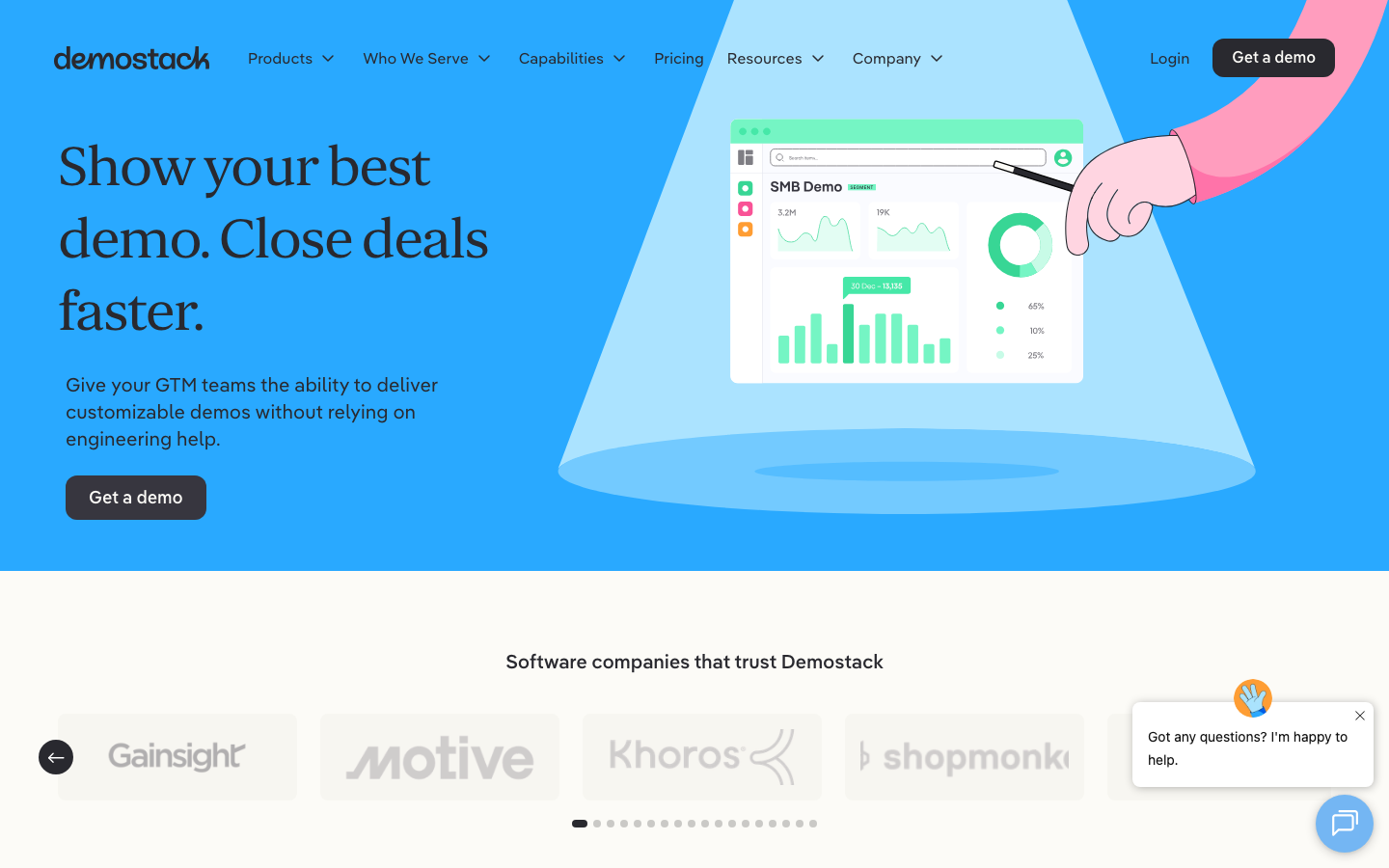
Demostack is an enterprise demo cloning platform. It captures your product's front end and recreates it as a sandboxed HTML environment that sales reps can walk prospects through on live calls. The clone looks and behaves like your real application, but runs independently, with no connection to production data or infrastructure. Customers include WalkMe, Gainsight, Yotpo, Intercom, Wix, Ironclad, and Gusto. Annual contracts range from $25,000 to $55,000 per year. There is no self-serve signup, no free trial, and no monthly billing.
Demosmith is an AI Demo Agent. You paste a product URL, describe the flow you want in plain English, and an autonomous AI agent navigates your product, captures the screens, and delivers a polished MP4 video with voiceover, transitions, captions, and branding in about 10 minutes. No cloning. No recording. No editing. Pricing starts at $40 per month with a free trial.
One builds live sandbox environments for enterprise sales teams. The other generates finished video demos from a URL. The price gap alone tells you these are built for different organisations. This comparison lays out what each tool does, where each one excels, and how to decide which approach matches your go-to-market motion.
At a Glance: Demosmith vs Demostack
| Feature | Demostack | Demosmith |
|---|---|---|
| Category | Demo environment / sandbox platform | AI demo video generator |
| Output Format | Interactive HTML sandbox | MP4 video + shareable link |
| How It Works | Clones product front end into HTML environments | AI agent navigates your product from a URL |
| AI Voiceover | No | Yes, 29 languages |
| Video Export | No | MP4 download + hosted link |
| CRM Integration | Yes, Salesforce, HubSpot, and more | No |
| Free Trial | No trial, no free tier | Yes, no credit card required |
| Multi-Language | Text localisation available | 29 languages (voiceover + captions) |
| Starting Price | ~$25,000/yr (annual contract, sales-led) | $40/mo | Monthly billing |
| Setup Time | Weeks (engineering involvement required) | Minutes |
| Best For | Enterprise sales teams running live sandbox demos | Video-first demos for marketing, sales, and PLG |
What Demostack Does
Demostack is purpose-built for enterprise sales organisations that need controlled, replicable demo environments for live prospect interactions. It has established a strong position serving large sales teams at companies with six-figure annual contract values. Here is what it offers.
Product Cloning and Sandbox Environments
Demostack's core technology captures your product's front end and recreates it as a fully interactive HTML environment. This is not a screenshot or a screen recording. It is a working clone that looks and behaves like your real application, running in a sandboxed environment where you control what data appears, what features are accessible, and how the experience flows.
For enterprise sales teams, this solves a concrete set of problems. The demo never crashes. Test data never shows real customer information. A new deployment cannot break the demo flow minutes before a call. The environment is stable, predictable, and repeatable across every rep on the team.
Demo HQ
Demo HQ is Demostack's centralised management layer. Sales teams organise demo environments by use case, vertical, or deal stage. Managers can track which demos reps are using, how prospects interact with them, and which environments drive the most engagement. For organisations with dozens of reps running hundreds of demos per quarter, this governance layer matters.
Overlay and Personalisation
Demostack Overlay lets teams customise the demo environment with prospect-specific data. Company name, logo, industry terminology, and relevant metrics can be injected into the clone before a sales call. Integrations with Salesforce and other CRM systems allow this personalisation to happen automatically based on deal records.
This is where Demostack delivers genuine value that no video tool can replicate. A prospect seeing their own company name and data inside a live product walkthrough during a sales call creates an experience that a pre-recorded video cannot match. Enterprise sales teams selling $100K+ annual contracts use this personalisation as a competitive differentiator.
Product Tours and Self-Service Demos
Beyond live sales demos, Demostack offers guided product tours that prospects can explore on their own. These interactive tours walk visitors through key workflows without needing a sales rep present. The tours run inside the same sandboxed clone environment, which means the experience is consistent across live and self-service interactions.
Mobile Demo Support
Demostack has been building mobile demo capabilities (currently in beta). This allows sales teams to demonstrate mobile product experiences using the same cloning and sandbox approach. For companies with mobile apps alongside web applications, this extends the demo platform across platforms.
Enterprise Security and Compliance
Demostack holds SOC 2 Type I and Type II certifications. For enterprise buyers with strict security requirements, this compliance posture is a prerequisite for procurement. The sandboxed architecture means no real customer data ever enters the demo environment, which reduces risk for regulated industries.
What Demosmith Does
Demosmith approaches product demos from a different direction entirely. Instead of cloning your product into a sandbox, it generates a finished video from your product URL. The whole workflow is autonomous and produces a distributable asset in minutes.
Autonomous Product Navigation
You provide a URL and a plain-English description of the demo flow. Demosmith's AI agent opens your product in a cloud browser and navigates autonomously: clicking buttons, filling forms, scrolling pages, and moving through multi-step workflows. No Chrome extension. No manual screen capture. No step-by-step instructions for each click.
The agent injects realistic test data into forms. Instead of "test@test.com" and "John Doe," it generates contextually appropriate names, emails, and content that make the demo look like a genuine user session. This detail has a measurable impact on how professional the output appears.
AI Voiceover in 29 Languages
Demosmith generates natural-sounding voiceover narration synchronised to the visual flow. The script is written by AI to match what is happening on screen, and the voice tracks with the pacing of the demo rather than sitting as a disconnected audio layer. Twenty-nine languages are supported, covering English, Spanish, French, German, Japanese, Korean, Portuguese, Chinese, Arabic, and twenty more.
For teams selling internationally, one prompt produces the demo in your primary language. Regenerating in another language takes minutes. No translator. No native speaker recording session. No separate localisation project.
Auto-Editing and Brand Kit
The raw capture goes through automated post-production. Demosmith adds smooth transitions between scenes, dynamic zoom effects that highlight the relevant part of the interface, synchronised captions for accessibility and silent viewing, and pacing that matches the voiceover. You configure your brand colours, logo, fonts, and intro/outro sequences once, and every video matches your brand identity automatically.
The output does not require a trip through Premiere Pro or Final Cut. The video arrives ready to publish. Teams that need granular adjustments can make them, but most users find the auto-editing sufficient for marketing and sales content.
MP4 + Shareable Link
Every Demosmith demo produces a downloadable MP4 file and a hosted shareable link. The MP4 works anywhere video works: YouTube, LinkedIn, sales decks, email attachments, website embeds, conference displays, learning management systems. The shareable link provides a hosted viewing experience with analytics. Video is the most portable content format in B2B marketing. It goes where interactive HTML sandboxes cannot.
10-Minute Turnaround
From URL to finished video, the typical turnaround is under 10 minutes. There is no setup period, no onboarding call, and no multi-week configuration. You can sign up, paste a URL, and have a polished demo video before your next meeting. For teams evaluating AI demo video generators, this speed difference against manual tools is one of the most frequently cited advantages.
Key Differences Between Demosmith and Demostack
Category: Demo Environments vs Demo Videos
This is the fundamental distinction. Demostack builds live, interactive environments. Demosmith produces video files. These are different asset types that serve different distribution channels and different moments in the buyer journey.
An interactive sandbox works when a sales rep is on a live call, guiding a prospect through the product in real time. A video works when the prospect is watching on their own, on any device, at any time. The two formats are complementary, not interchangeable. Teams that need interactive demos vs video demos face a format decision first, and a vendor decision second.
Output: Interactive HTML vs MP4
Demostack's output is an interactive HTML environment that requires a browser and, in most cases, a human operator walking the prospect through it. Demosmith's output is an MP4 video file that plays on any device, in any channel, at any time, without someone driving it.
Video goes on YouTube, in LinkedIn posts, in email attachments, on conference booth screens, in paid ads, and in learning management systems. Interactive HTML sandboxes do not work in any of those channels. That said, video cannot respond to a prospect's questions or show their own data in real time. Each format has clear strengths and clear limitations.
Pricing: $50K/yr vs $40/mo
Demostack's annual contracts range from $25,000 to $55,000 per year. There is no monthly billing, no free tier, and no self-serve signup. The sales process requires multiple calls, a security review, and a signed annual agreement. This pricing reflects Demostack's enterprise positioning.
Demosmith starts at $40 per month with monthly billing. Pro is $99 per month. Business is $250 per month. Enterprise is custom. A free trial is available with no credit card required. You can sign up and generate your first demo video in minutes.
The arithmetic is stark. One year of Demostack at $50,000 covers more than 16 years of Demosmith at $40 per month. For teams that have explored Demostack alternatives, this pricing gap is the first thing they notice. That said, the comparison is somewhat misleading because the two tools serve different purposes. You would not compare the price of a video editing tool to the price of a CRM system. The same logic applies here.
Setup: Weeks of Engineering vs Minutes
Demostack requires meaningful engineering involvement to get started. Cloning a product's front end, configuring the sandbox environment, setting up data overlays, connecting CRM integrations, and building out the first set of demo templates takes weeks. The initial setup is a project, not a signup.
Demosmith's setup is a URL and a text prompt. There is nothing to clone, no environment to configure, and no editor to learn. The learning curve is measured in minutes, not weeks. You describe the demo you want, and the AI agent handles the capture and production.
Engineering Requirement: Mandatory vs None
Demostack's cloning process typically requires engineering resources. Someone needs to help the platform capture your product's front end accurately, handle authentication flows, and ensure the clone behaves correctly across key workflows. For complex products with dynamic interfaces, this engineering effort is ongoing. Every time your product ships a significant UI update, the clone needs attention.
Demosmith requires zero engineering involvement. The AI agent navigates the live product directly. When your UI changes, you re-run the same prompt against the updated product and get a new video. No engineer needed for the initial capture or for updates.
Target Customer: Enterprise Sales vs All Teams
Demostack targets enterprise sales organisations exclusively. Its pricing, sales process, feature set, and security certifications all point at large companies with dedicated sales teams, presales engineers, CRM infrastructure, and procurement budgets. If you are a 15-person startup or a product-led growth company, Demostack is not designed for you.
Demosmith serves a broader range of teams. Product marketers creating website hero videos. Sales teams building demo libraries for outbound campaigns. Customer success teams producing onboarding walkthroughs. Growth teams running PLG motions. International teams localising demos across markets. The flat pricing model and self-serve signup make it accessible to teams of any size.
When Demostack Is the Better Choice
Demostack is the right tool for enterprise sales teams running live, guided demo calls with high-value prospects where the sales rep needs full control over the product environment. If your sales motion involves showing a prospect their own company data inside an interactive product walkthrough, Demostack's HTML cloning and CRM integrations are purpose-built for that workflow.
Large organisations with established presales teams and demo engineering functions get the most value. Companies like WalkMe, Gainsight, and Ironclad use Demostack because the sandboxed, personalised demo environment aligns with how their enterprise sales teams operate. The SOC 2 compliance, the governance layer in Demo HQ, and the ability to manage dozens of demo templates across multiple verticals are features that matter at scale.
Teams selling $100K+ annual contracts, where a single deal justifies the entire year's Demostack investment, will find the ROI straightforward. If your average deal size is six figures, your sales cycle involves multiple live demo calls per deal, and you have engineering resources to support the initial clone setup, Demostack fits that specific use case well.
Partner enablement is another strong use case. If you need to give channel partners or resellers access to a controlled demo environment that always works and always shows the right data, Demostack's sandbox approach provides that consistency without exposing your production environment.
When Demosmith Is the Better Choice
Demosmith is the right tool when you need polished demo videos that work across every distribution channel, not just live sales calls. Product marketing teams producing website hero videos, YouTube content, social media clips, and sales enablement libraries get more from a video output than an interactive sandbox. Video goes where HTML cannot: LinkedIn feeds, email attachments, conference screens, paid ads, and learning management systems.
Founders and early-stage teams benefit from the $40 per month entry point. You do not need a $50,000 contract to produce professional demo content. A founder preparing for a fundraising pitch, a product launch, or a cold outreach campaign can generate a finished demo video in 10 minutes without any engineering help.
Teams running product-led growth motions, where the demo needs to sell the product without a human guide, benefit from a self-contained video that communicates the full value proposition in two to three minutes. Teams selling internationally benefit from 29-language voiceover and caption support that collapses a multi-week localisation project into an afternoon.
Customer success teams producing onboarding videos, training materials, and feature announcements can use Demosmith to keep their video library current as the product evolves. When the UI changes, re-running the original prompt produces an updated video. Twenty demos can be regenerated in parallel. The maintenance burden scales with the number of saved prompts, not the hours available on someone's calendar.
SMBs and mid-market companies that need demo content but lack enterprise budgets or presales teams get the most from Demosmith's approach. The autonomous workflow removes the recording step, the editing step, and the ongoing maintenance that makes demo content go stale. The time investment is a text prompt. The output is a finished, branded MP4 ready for any channel.
The Bottom Line
Demostack and Demosmith serve different jobs. Demostack builds interactive, personalised sandbox environments for live enterprise sales conversations. Demosmith generates polished video demos autonomously from a URL. The choice between them is not about which is better in the abstract. It is about which output format and workflow matches the way your team actually uses demos.
If your primary use case is live, guided sales calls with enterprise prospects who expect to see their own data in an interactive product walkthrough, Demostack's HTML cloning and CRM personalisation are built for that. The price tag reflects the enterprise positioning, and for organisations where a single closed deal covers the annual cost many times over, the investment makes sense.
If your primary use case is producing demo videos for marketing, sales enablement, website content, social distribution, multilingual markets, or any channel where video is the native format, Demosmith produces that output in minutes at a fraction of the cost. The autonomous approach removes the recording step, the editing step, and the maintenance burden that makes demo libraries go stale.
Some enterprise teams will use the two together. A sandbox platform for live sales calls and a video tool for everything else. The two formats are complementary rather than competitive. A combined approach often costs less than Demostack alone.
Demostack clones your product into a sandbox for a live sales call. Demosmith turns your product into a video anyone can watch, in any language, on any channel. One requires a rep, engineering resources, and a $50K contract. The other requires a URL.
Key Takeaways
- Demostack creates interactive HTML sandbox environments for live enterprise sales demos. Demosmith generates polished MP4 demo videos autonomously from a URL. They produce different outputs for different channels.
- Demostack costs $25,000 to $55,000 per year with mandatory annual contracts and no free trial. Demosmith starts at $40 per month with monthly billing and a free trial requiring no credit card.
- Demostack's CRM-driven personalisation and SOC 2 compliance are genuine strengths for enterprise sales teams that need prospect-specific data in live sandbox environments. No video tool replicates this.
- Demosmith supports AI voiceover in 29 languages and produces video that works on YouTube, LinkedIn, email, conference screens, and paid ads. Interactive HTML sandboxes do not work in these channels.
- Demostack requires weeks of engineering setup and ongoing maintenance as your product UI changes. Demosmith requires a URL and a text prompt, and regenerates updated demos in 10 minutes.