
Why Your Pitch Deck Alone Is Not Enough
The average investor spends 2 minutes and 24 seconds reviewing a pitch deck. For seed-stage decks, that number drops to 1 minute 56 seconds (DocSend, 2024). That is less time than it takes to microwave leftovers.
Now consider the competition. A typical VC sees 5,000 pitches per year, reads 600 to 800, and funds zero to two. Only 1% of pitch decks secure funding. Your 14-slide deck is fighting for attention against thousands of others that look nearly identical.
Static slides cannot show what your product actually does. They describe it. They gesture at it with screenshots and diagrams. But they do not let an investor experience the product in motion. That gap between "telling" and "showing" is where most pitches lose momentum.
A 60-second demo video closes that gap. It shows the product working, in real time, with real interactions. The investor sees what users see. No imagination required. And the data backs this up: founders who include demo videos in their pitch materials close at nearly double the rate of those who rely on decks alone.
This guide covers the research, the examples, and the exact playbook for building demo videos into your fundraising process. If you are new to AI-powered demo video tools, start there for a broader overview. Otherwise, read on.
The Numbers: Why Demo Videos Work in Fundraising
The case for demo videos is not anecdotal. The data is clear across multiple contexts.
Close rates double. VCs who watched a demo video closed at 67%, compared to 34% for decks alone (DocSend via Flowjam). That is a 2x lift in the most important metric of your fundraise.
Crowdfunding tells the same story. Kickstarter campaigns with video succeed at 50%, versus 30% without. Indiegogo campaigns with video raise 115% more money. The pattern holds whether you are pitching a VC partner or a crowd of backers: moving pictures outperform static ones.
Retention explains why. Viewers retain 95% of a message when they watch it on video, compared to 10% when they read text. Your pitch deck lands in the 10% camp. A demo video puts you at 95%. When an investor finishes watching your demo, they remember what your product does. When they finish reading your deck, they remember your font choice.
Silent viewing is the norm. 85% of social video plays happen on mute. This matters because investors often scan materials during calls, in transit, or between meetings. Captions are not optional. They are the primary way most investors will consume your demo video the first time they see it.
These numbers point to a single conclusion: if you are raising money and your pitch materials do not include video, you are leaving close rate on the table.
Famous Startup Demo Videos That Raised Millions
The most iconic fundraises in tech history share a common thread. The founders showed the product instead of describing it.
Dropbox
Dropbox had no working product when Drew Houston needed to prove demand. He recorded a 4-minute demo video showing what the product would do, walking through file syncing as if it already worked. The video served as the MVP itself. The waitlist jumped from 5,000 to 75,000 overnight. Sequoia invested $1.2M at seed. The demo video was the pitch.
Rewind AI (now Limitless)
Rewind AI released a demo video before launch showing its always-on memory assistant in action. The video drove 300,000 signups before the product was publicly available. The company raised $10M before launch. Investors could see the concept working, which made the bet feel far less abstract than a slide deck about "AI-powered personal memory."
Outset.ai
Outset.ai published a 78-second launch video alongside their $17M Series A announcement. The LinkedIn post featuring the video outperformed their blog announcement by 3x. Short, visual, and direct. The video did not try to explain the entire platform. It showed one compelling workflow and let viewers draw their own conclusions.
Buffer
Buffer combined demo videos with radical transparency about metrics and revenue. The videos showed the product in action while the founders shared real numbers publicly. This approach helped Buffer raise $3.9M. The demo videos gave investors confidence that the product worked. The transparency gave them confidence in the team.
Docker
Docker used early demo videos to explain a concept that was genuinely difficult to grasp from slides alone: containerisation. The videos showed developers spinning up isolated environments in seconds, making the value proposition visceral rather than theoretical. Docker went on to raise $283M. For a product that required conceptual understanding before investors could evaluate it, video was essential.
Five Types of Demo Videos for Investor Pitches
Not every fundraising situation calls for the same format. Here are five types of demo videos that serve different purposes in the investor pipeline.
1. Product Walkthrough
A screen-captured tour of your product in action, showing the core workflow from start to finish. This is the most common and most versatile type. Keep it under 90 seconds. Lead with the problem, show the solution, end on the outcome. This is what Dropbox and Outset.ai used to great effect.
2. Animated Explainer
Best for products where the value is conceptual or the UI is not yet built. Motion graphics illustrate the problem, the market, and the solution in a visual narrative. Works well for pre-product raises and deep-tech companies where a screen recording would not convey the full picture.
3. Narrated Deck Walkthrough
A voiceover recording of your pitch deck with transitions and annotations. Useful for cold outreach when you cannot get a meeting. The investor watches your deck with your narration guiding them through it. It is not a pure demo video, but it outperforms a raw PDF every time because it controls pacing and emphasis.
4. Live Product Demo (Recorded)
A recording of you using the product live, with your voice explaining what you are doing and why it matters. This format conveys founder energy and conviction. Front CEO Mathilde Collin used live product demos as part of her pitch process on the way to $79M in funding. The risk: one wrong click and you lose the momentum.
5. Pre-recorded Backup Demo
A polished, scripted demo video you keep ready for when live demos fail. WiFi drops. Staging servers go down. APIs time out. Having a pre-recorded backup means you never lose a pitch to a technical failure. Smart founders treat this as insurance, not a fallback.
How to Create an Investor Demo Video in 10 Minutes
The traditional route for a 60-second produced demo video costs $1,000 to $6,000 and takes 3 to 8 weeks with an agency. Most early-stage founders cannot afford that timeline or that budget. An AI demo agent changes the equation entirely.
Here is how to create an investor-ready demo video with Demosmith in under 10 minutes.
Step 1: Define Your Flow
Pick the single workflow that best demonstrates your product's value. Think of it as a story, not a feature tour. Start with the problem state (empty dashboard, unresolved ticket, blank canvas) and end with the outcome (insight generated, issue resolved, design complete).
Keep the flow to 4 to 6 steps. If you need a script template, our demo video script guide walks through the exact structure.
Step 2: Paste Your URL
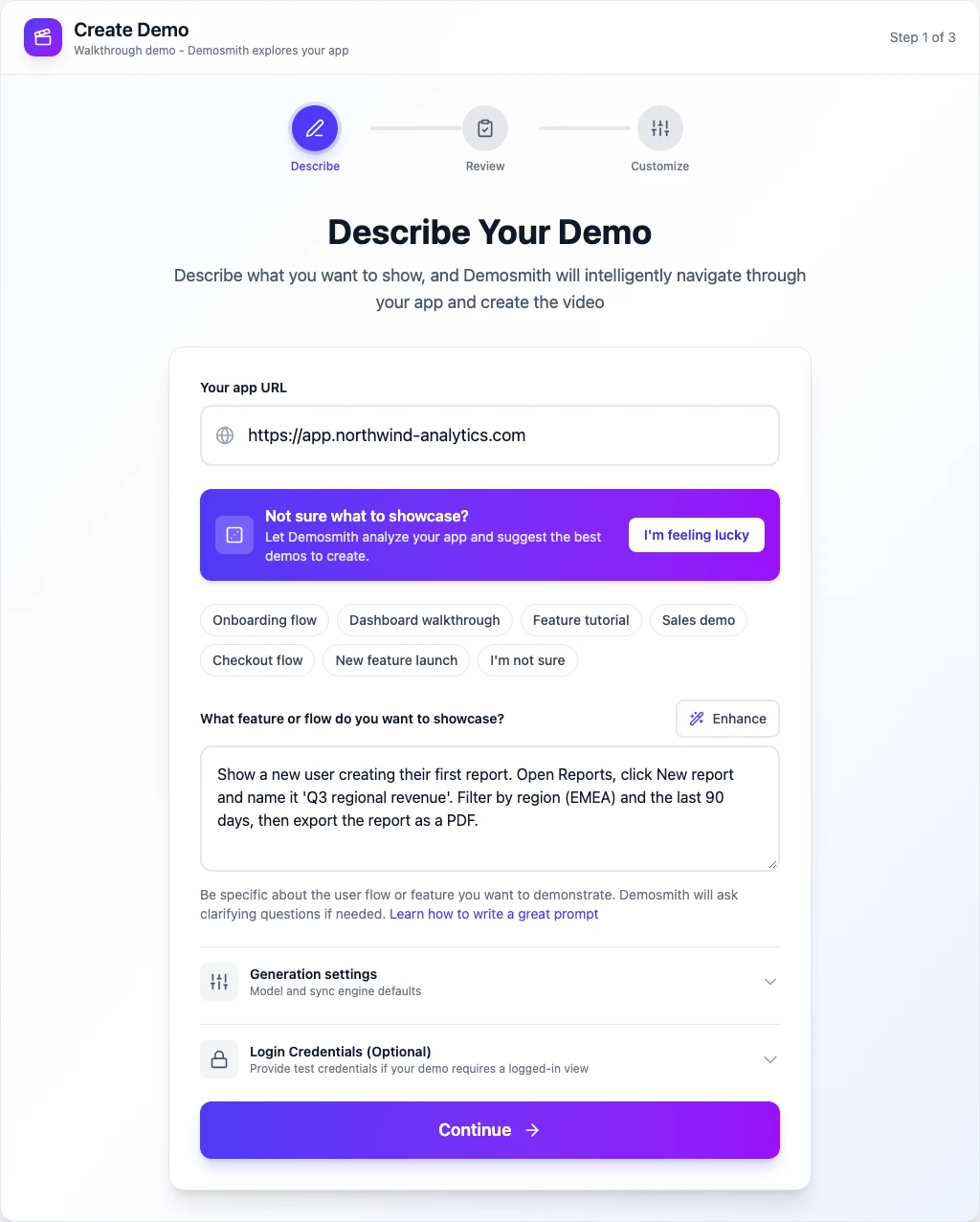
Enter your product URL into Demosmith and describe the flow in plain language. The AI demo agent launches a cloud browser, navigates your product autonomously, clicks through the workflow you described, and captures high-resolution footage of every step. No screen recording. No manual clicks. No retakes.
Step 3: Generate
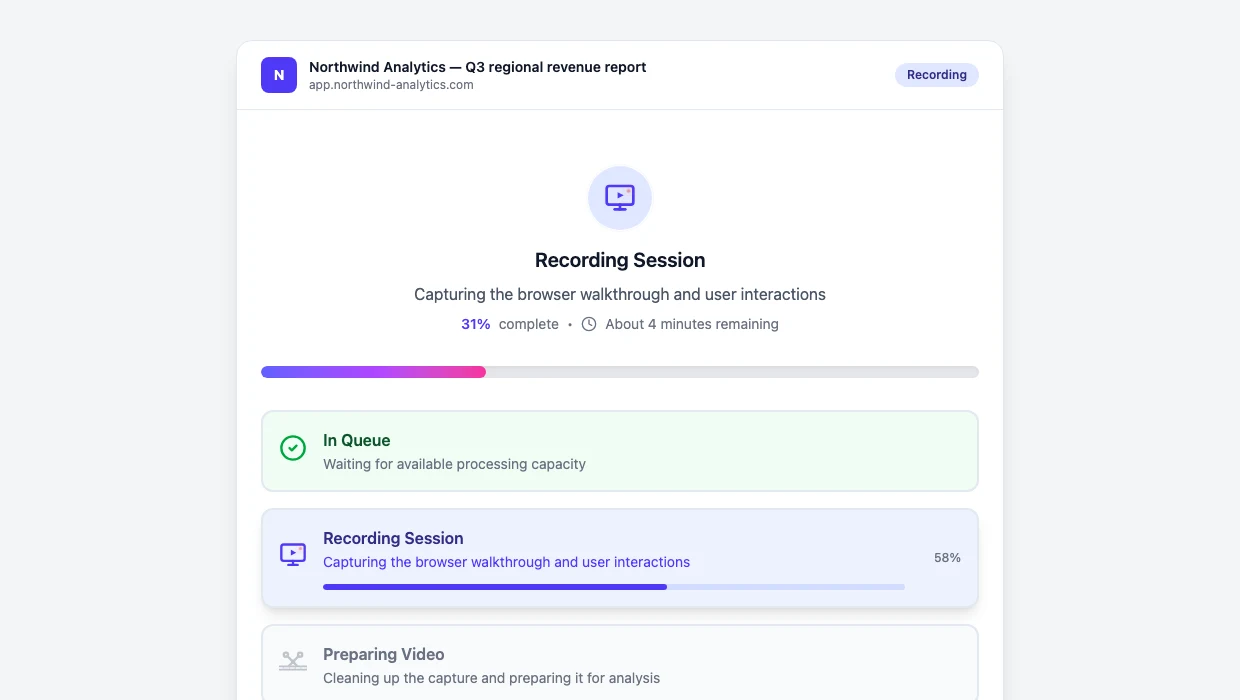
Demosmith handles the rest: auto-editing with transitions and zoom effects, AI voiceover narration, captions, and brand kit application. The output is a polished MP4 with a shareable link.
Step 4: Add Captions and Localise
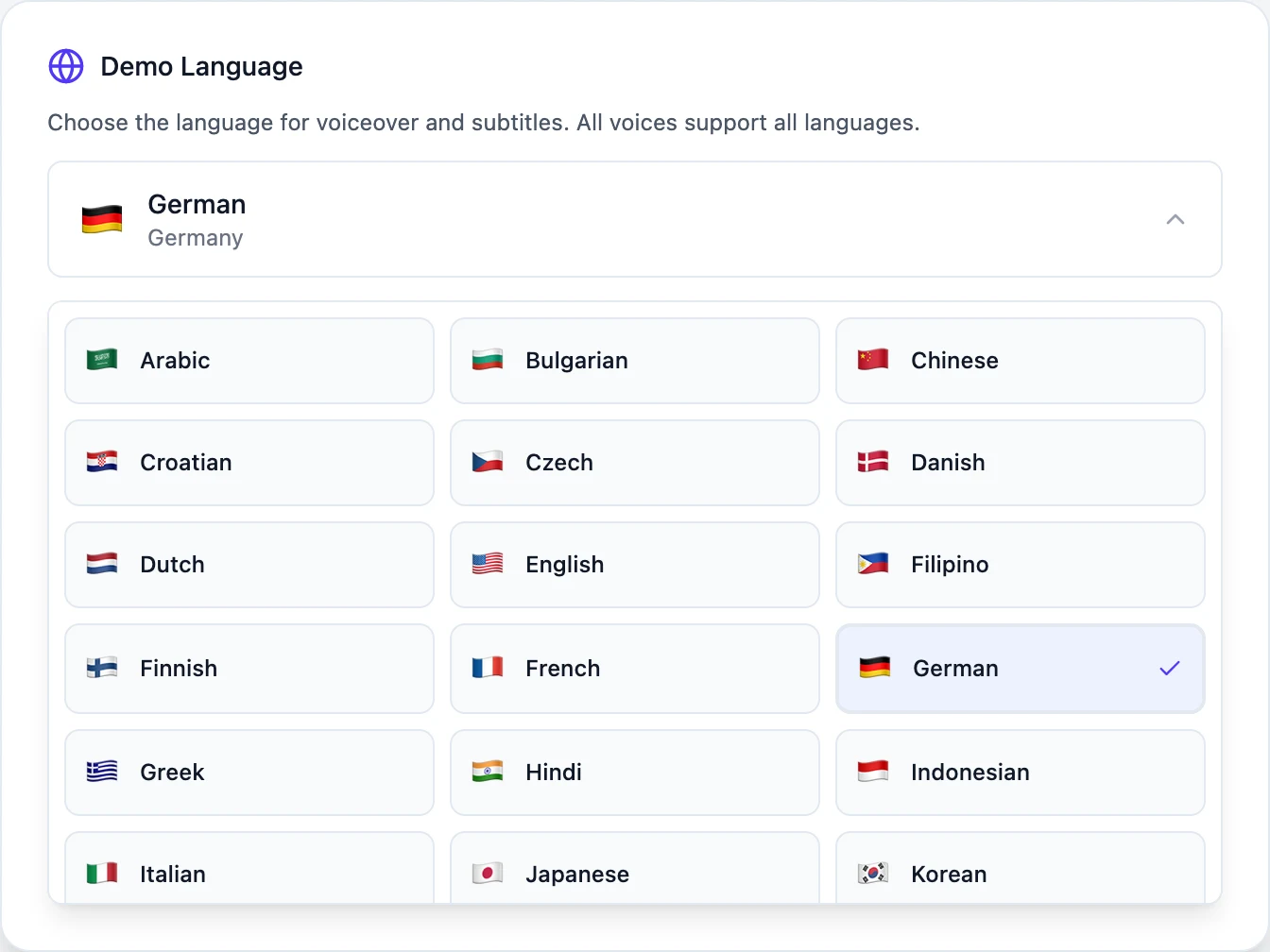
Since 85% of video plays happen on mute, captions are critical. Demosmith generates captions automatically. If you are pitching international investors, switch the voiceover and captions to any of 29 supported languages without re-recording anything.
Step 5: Review and Ship
Watch the output. Adjust pacing or narration if needed. Export. Your investor demo video is ready.
Total cost: Demosmith starts at $40/month (Starter plan). Total time: under 10 minutes. Compare that to $1,000 to $6,000 and 3 to 8 weeks with an agency, and the decision makes itself.
What VCs Actually Want to See
Founders tend to over-engineer their demo videos. They try to show every feature, every integration, every settings panel. VCs want the opposite.
Brendan Baker, a partner at Rackhouse VC, put it directly: "With investors, you are using the product to tell a story about your company. It is more illustrative and less exhaustive." He added: "Do not show an investor absolutely everything. Give them the quick lay of the land, then pick a few powerful workflows."
That advice runs counter to every founder's instinct. You built the product. You want to show all of it. Resist that urge. A 60-second video that nails one workflow will outperform a 5-minute tour that covers everything.
Lead with the Problem
Start your demo by showing the pain, not the product. If you solve expense reporting, show the messy spreadsheet first. If you automate onboarding, show the 47-step manual checklist. The problem creates context. The product becomes the resolution.
Show the "Aha Moment" in the First 15 Seconds
Investors decide whether to keep watching almost immediately. Front-load the most impressive interaction. If your product generates a report in one click that used to take hours, show that click in the first 15 seconds.
Keep It Under 90 Seconds
Bo Nam, founder of Ludis Analytics, had a 7-minute demo and was getting lukewarm responses. He split it into six separate 1-minute videos, each focused on a single feature. The result: "faster and more positive reactions" from investors. Length kills momentum in fundraising. Shorter is almost always better.
Replace Paragraphs with Video Links
Bo Nam also started replacing long email paragraphs with Loom links in his investor outreach. He saw a "material increase" in conversion rate. The same principle applies with any demo video tool. Instead of writing three paragraphs explaining what your product does, send a 60-second video that shows it.
The best investor demo videos do not explain the product. They make the investor feel what it is like to use it.
Where to Use Your Demo Video in the Fundraising Process
Creating the demo video is step one. Distributing it strategically across the fundraising pipeline is what drives results. The average seed-stage founder meets 50+ investors before closing, and the average time to close a seed round is 5.2 months (NVCA). Every touchpoint matters.
Cold Outreach
The first email to an investor is where most founders lose. A wall of text describing the product gets skimmed and forgotten. A 60-second demo video link stands out. It takes less effort for the investor to click play than to parse four paragraphs. For a deeper playbook on this approach, see our guide on using demo videos in cold outreach.
The Pitch Meeting
Open your pitch with the demo video, not slides. This is counterintuitive, but effective. The video grabs attention immediately, sets context for everything that follows, and lets you skip the "let me show you the product" section of the meeting. After the video, move into market size, traction, and team. The investor already understands what you are building.
The Data Room
Every serious investor will ask for a data room. Include your demo video alongside the financials, cap table, and legal docs. This is where the video gets its second and third view. Partners who were not in the meeting watch it here. Associates reviewing the deal watch it here. Make sure the video works on mute with captions, because that is how most data room content gets consumed.
The Follow-up Email
After the meeting, send a follow-up with the demo video embedded. Investors talk to dozens of founders per week. Your follow-up email is competing with every other follow-up in their inbox. A video thumbnail gets clicked. A paragraph of text gets scanned.
Investment Committee
This is the stage most founders forget about. VCs share materials with their investment committee during due diligence. Your demo video becomes your proxy in a room you are not invited to. The partners who championed your deal use the video to make the case to the rest of the team. A strong demo video does your selling for you when you cannot be there to do it yourself.
Conclusion
Your product is not a slide. Stop pitching it like one.
Investors are drowning in decks. They have two minutes of attention and thousands of founders competing for it. A demo video cuts through that noise in a way that no slide, no paragraph, and no bullet point can match.
The founders who raised millions from Dropbox to Rewind AI to Docker understood this instinctively. They showed the product. They made investors feel what it was like to use it. And they closed faster because of it.
You do not need an agency, a production budget, or weeks of lead time. You need 10 minutes and a clear story about what your product does.
There is one exception. If you are raising on a concept rather than a working product, or you want a produced launch film instead of a product walkthrough, that is studio work and no tool replaces it. For startups looking for viral launch videos, Flowjam has shipped 100+ videos for YC-backed companies including HeyGen (7M views) and Bloom (1.5M views).
Key Takeaways
- Investors spend under 2.5 minutes on your deck. A 60-second demo video holds attention and doubles close rates (67% vs 34%).
- Lead with the problem, not the feature list. Show the "aha moment" in the first 15 seconds.
- Keep investor demos under 90 seconds. Split longer videos into focused, single-workflow clips.
- Captions are mandatory. 85% of video plays happen on mute, and investors review materials between meetings.
- Use your demo video at every stage: cold outreach, pitch meeting, data room, follow-up, and investment committee.
- Tools like Demosmith generate investor-ready demo videos in under 10 minutes for a fraction of agency costs. No recording or editing required.