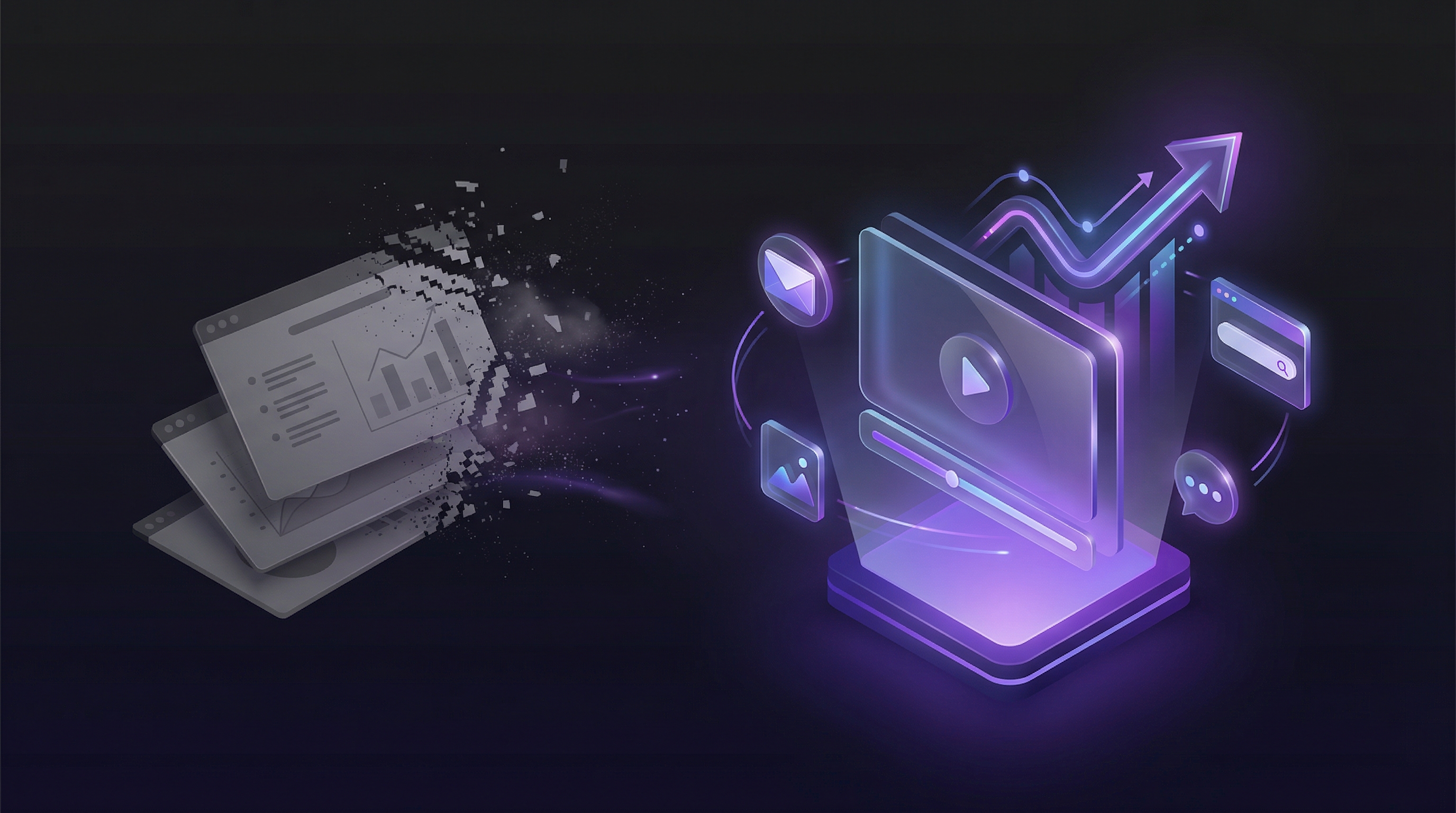
Storylane built 7,000+ demo pages, scaled from 20K to 220K monthly visits, and hit a 28.8% bounce rate on content that most SaaS companies would kill for. They proved that demo content can be a primary growth channel. But their version of demo-led growth is built entirely around interactive click-through demos. That is only half the picture.
Video demos reach places interactive demos cannot. They work in email, on YouTube, in paid ads, across social media, and inside Slack threads where champions share them with decision-makers. The companies that figure out how to combine the proven demo-led SEO playbook with video-first distribution will own the next wave of SaaS growth.
This is the playbook for doing exactly that.
What is demo-led growth (and why video changes everything)
Demo-led growth is a go-to-market strategy that uses demo content as a primary growth channel. Instead of gating product access behind sales calls and lead forms, demo-led companies make the product visible at every touchpoint. Prospects can see the product in action before they sign up, talk to sales, or commit to anything.
Storylane popularised the term. They built a programmatic SEO engine around interactive demos, creating thousands of demo pages that each target a specific use case or workflow. Their results: 28.8% bounce rate versus the 70% industry average for B2B SaaS, 71.2% engagement rate, pages ranking in Google within 10 days of publication. That demo-led growth framework clearly works.
But interactive click-through demos are only one format. They live on your website and require the viewer to actively click through each step. Video demos work in email, on YouTube, as paid ads, in social feeds, and in Slack threads where your champion is trying to get buy-in from their VP. Video tells a controlled narrative with voiceover and pacing. It requires zero effort from the viewer. 73% of B2B decision-makers prefer watching demo videos over reading whitepapers.
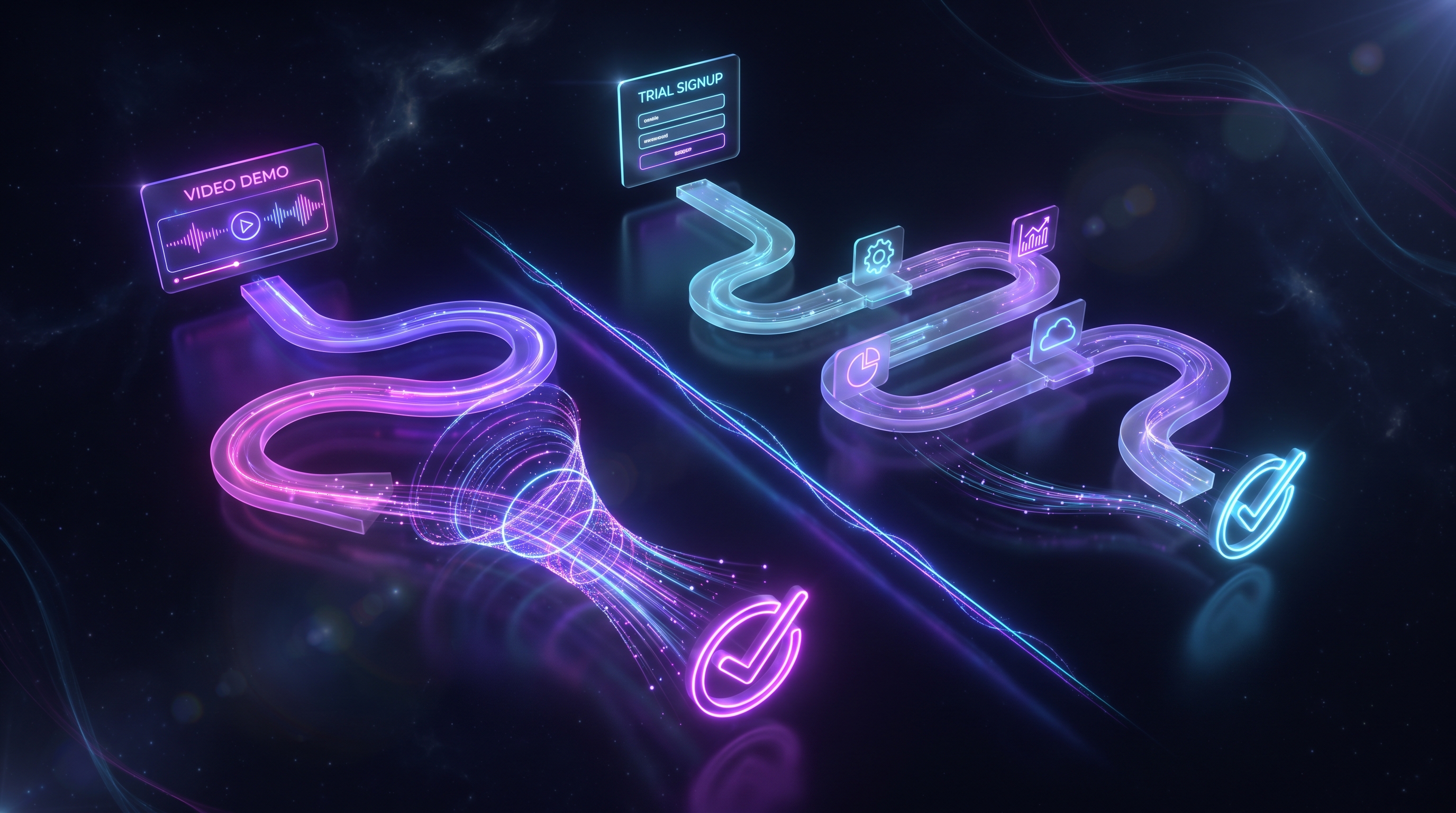
Video-first demo-led growth takes Storylane's framework and extends it beyond the website. Video demos work everywhere, not just on pages you control. Any company serious about demo-led growth needs both formats, but video is the one most teams have ignored. And since September 2026, needing both formats no longer means buying two tools: Demosmith compiles interactive demos from the same recordings that produce its videos.
Where video demos beat interactive demos (and vice versa)
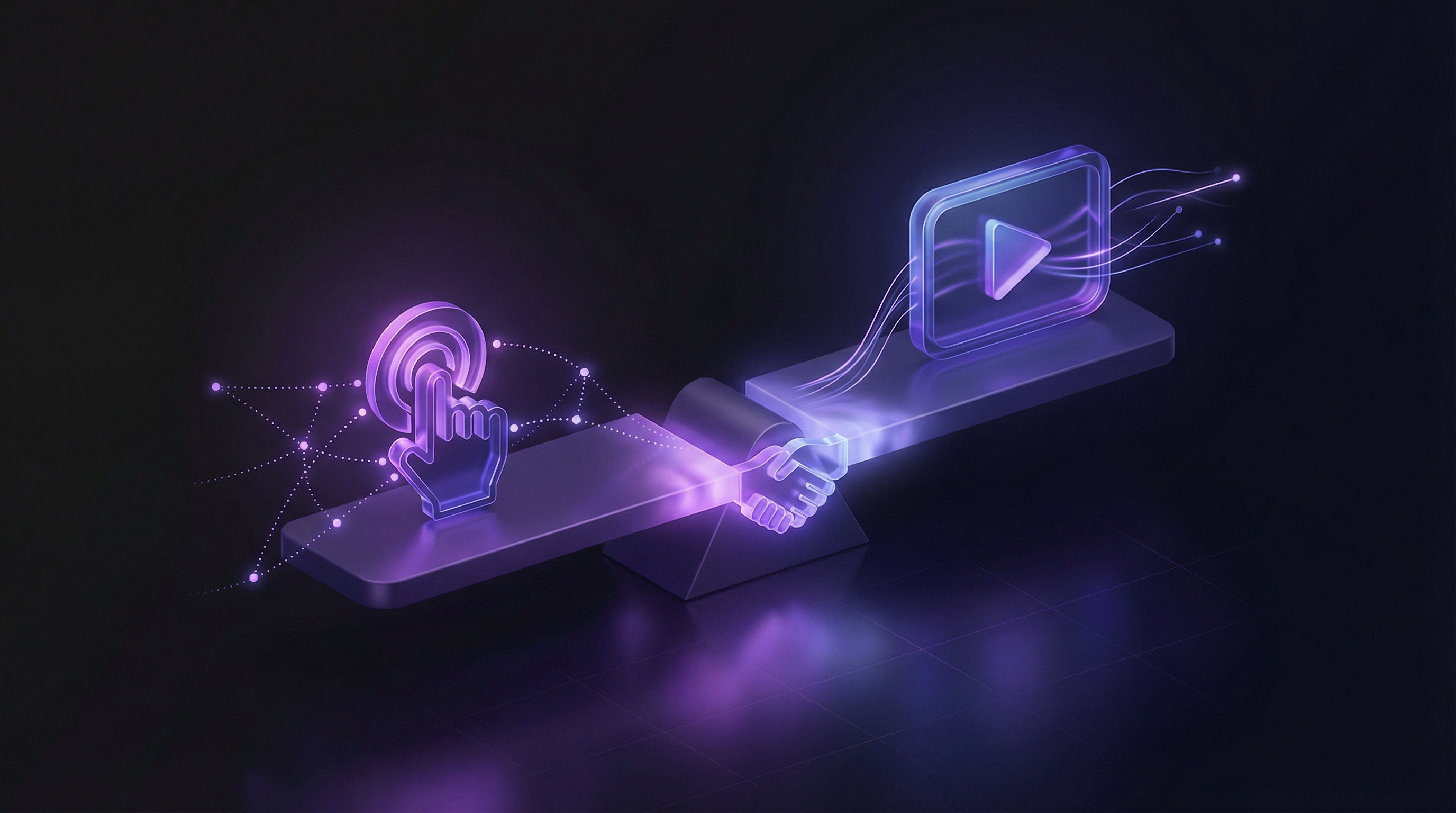
This is not an either/or decision. Both formats serve real purposes, and honest analysis matters more than tribal loyalty to one approach. For a deeper comparison, read the full breakdown of interactive demos vs video demos.
Interactive demos win when prospects want to explore at their own pace. They are excellent for products with visual UIs that benefit from hands-on interaction. They generate granular click-tracking analytics that reveal exactly where prospects drop off in a workflow. And they work well on your website, where visitors arrive with intent and are willing to engage actively with a guided tour.
Video demos win everywhere else. Email clients do not render interactive demos. YouTube does not host them. LinkedIn feeds do not support them. Ad platforms cannot run them. If the demo needs to leave your website, video is the only option. Video also gives you control over narrative and pacing, with voiceover that makes complex workflows clear without requiring the viewer to figure out UI elements on their own. And here is the thing that matters most in enterprise sales: a champion can forward a video to their VP, their CFO, and their legal team. That solves the "I saw the demo but my VP did not" problem that kills deals. 97% of B2B buyers say they would be more receptive to sales communications after viewing video content.
The gap in most companies is not interactive demos. Tools like Storylane, Arcade, and Navattic have made those accessible. The gap is video. Most SaaS companies still have zero or one demo video on their entire site, while their prospects are searching YouTube, watching social feeds, and forwarding videos in Slack.
Video demos as an SEO channel
Storylane proved that demo content drives organic search performance. The dynamics are similar for video, but video has two advantages interactive demos do not: it improves engagement metrics on existing pages, and it opens up YouTube as a discovery channel.
Embedded video on blog posts and landing pages
Pages with embedded video convert at 4.8% compared to 2.9% for pages without video. That is a 65% improvement from a single content addition. Video increases time on page, reduces bounce rate, and sends strong engagement signals to search engines. These are exactly the metrics that correlate with higher rankings.
The practical move: take your existing high-traffic blog posts and landing pages, embed relevant demo videos, and measure the impact. You are not creating new pages. You are improving pages that already rank. A blog post about "how to set up automated workflows" converts better when it includes a 2-minute video showing the exact workflow in your product. Storylane proved this with interactive demos. The engagement dynamics are the same with video.
YouTube as a product discovery engine
90% of YouTube users say they discover new products on the platform. 50.9% of B2B decision-makers use YouTube for product research. YouTube processes 3 billion searches per month.
Yet almost no SaaS company exploits YouTube systematically for product demos. Most have a channel with a handful of outdated overview videos and nothing else. The opportunity is to build a YouTube demo library that covers every feature, use case, and integration your product offers. Each video targets a long-tail search query: "how to create a project in [your tool]", "[your tool] CRM integration demo", "[your tool] vs [competitor] comparison".
This was not practical when each video required hours of recording, editing, and production. AI demo video generators change that equation entirely, making it feasible to create dozens of YouTube-optimised demo videos in a fraction of the time.
The video demo funnel: from awareness to expansion
A single demo video can do more than sit on your homepage. Here is how video demos work at each stage of the funnel.
Awareness
At the top of the funnel, create 60-90 second overview videos for landing pages, paid ads, and marketing campaigns. Lead with the outcome, not the setup. Social audiences decide in 2-3 seconds whether to keep watching, so the first frame needs to show something compelling, not a logo animation. Video posts generate 1,200% more shares than text and image combined.
Show what your product does in under 90 seconds. Make the viewer want to learn more. That is the entire job of an awareness video.
Consideration
During evaluation, prospects need specificity. Create 2-4 minute videos for each major use case and persona, embedded on comparison pages, feature pages, and blog posts. A marketing director evaluating your product needs to see different workflows than an engineering manager. One overview demo does not serve both. 84% of consumers say watching a brand video convinced them to purchase a product or service.
This is where most demo libraries fall short. One or two generic videos do not address the range of questions buyers who self-educate before sales are trying to answer.
Decision
Personalised 3-5 minute demos for specific prospects solve a friction point that kills B2B deals. Your champion saw the live demo and loved it. Now they need to convince their VP, their CFO, and their legal team. Asking them to re-explain what they saw is a losing game. A video they can forward is not.
A 3-minute video that shows exactly how your product solves that prospect's specific problem travels through an organisation faster than any slide deck.
Onboarding
Short 60-120 second tutorial videos, one per workflow, reduce time-to-value and cut support ticket volume. New users do not want to sit through a 45-minute onboarding call. They want a 90-second video that shows them how to do the one thing they need to do right now. That same engagement lift you see on marketing pages applies to activation too.
Expansion
Show premium features the customer is not using yet. Keep these short and outcome-focused: "Here is what happens when you enable advanced reporting" works better than a feature spec sheet. CS teams that send targeted demo videos about underutilised features see higher expansion rates than teams relying on text-based emails or feature announcement banners.
For the broader framework on mapping demos to the full buyer journey, see the complete demo-led growth framework.
Why most teams fail at video-first demo-led growth
The strategy outlined above is not complicated. Map your funnel, identify the gaps, create demo videos for each stage and channel. The logic is obvious. The execution is where it breaks.
Traditional demo video production costs $1,000-5,000 per finished minute, and the true cost of product demo videos is even higher when you factor in maintenance. A single 3-minute use-case demo can take 8-12 hours to produce when you account for scripting, recording, re-recording (because someone clicked the wrong button on take 4), editing, voiceover, captions, and brand formatting. A 50-video library at manual production rates represents 200-400 hours of work. That is 5-10 weeks of a full-time person's time, assuming they do nothing else.
And then your product ships an update. The UI changes. Three buttons move. A new feature appears in the navigation. Now 15 of those 50 videos show an interface that no longer matches what prospects see when they sign up. You have two choices: live with inaccurate demos or spend another 60-120 hours re-recording them. Our guide on keeping demo videos evergreen covers three strategies for breaking this cycle.
Interactive demos scaled because tools like Storylane and Arcade made production fast. Arcade reports an average of 6 minutes from start to published demo. Video demos have not scaled because production has stayed manual, expensive, and fragile. That is why video-first demo-led growth has been a nice idea that nobody actually executes.
How AI makes video-first demo-led growth practical
AI demo agents change the production economics entirely. Instead of recording your screen, writing a script, editing footage, and adding voiceover manually, an autonomous AI agent does all of it.
Demosmith works like this: paste your product URL, describe the workflow you want to demonstrate, and the AI agent navigates your product, captures the interaction, applies smart editing, generates voiceover narration, adds dynamic captions, and applies your brand kit. Finished MP4 with a shareable link. Under 10 minutes. AI voiceover in 29 languages.
The 50-demo library that would take 200-400 hours of manual work becomes a one-day project. Refreshing demos after a product update is an afternoon, not a week. Production stops being the bottleneck, and you start thinking about distribution instead.
Demosmith pricing makes this accessible at any scale: Starter at $40/mo, Pro at $99/mo, Business at $250/mo, with Enterprise custom pricing available. Free trial, no credit card required. For a comparison of tools in this space, see the roundup of best AI demo video generators.
This is what makes video-first demo-led growth executable. The strategy only works at scale if production is fast and cheap. AI makes it both. For a deeper look at the production side, read our guide on scaling demo production.
The video-first playbook (step by step)
Here is how to actually do this. Five steps.
Step 1: Audit your current demo content
Map every touchpoint where prospects and customers interact with your brand. For each one, document whether the visitor can see your product in action. A screenshot does not count. A feature list does not count. Only count touchpoints where someone can watch a real product demonstration.
Common touchpoints: homepage, feature pages, pricing page, comparison pages, blog posts, email sequences, sales outreach, onboarding flow, help centre, social media, paid ads, YouTube, review site profiles. Most companies find that fewer than 20% of these touchpoints include any demo content at all.
Step 2: Create your core video library
Start with five videos. Not fifty. Five.
- One overview demo (60 seconds): what your product does, who it is for, and the primary outcome it delivers
- Three use-case demos (2-3 minutes each): your top three use cases, each showing a complete workflow from start to finish
- One competitive comparison demo (2-3 minutes): how your product handles a common workflow compared to the leading alternative
These five videos cover your highest-impact touchpoints: homepage, top landing pages, and the comparison page that captures competitive search traffic.
Step 3: Distribute across channels
A demo video sitting on one page is an underperforming asset. Each video should appear in multiple contexts:
- Website: embed on relevant landing pages and blog posts
- YouTube: upload with search-optimised titles and descriptions
- Email sequences: add video thumbnails linking to demo pages
- Sales team: equip reps with video links for outreach
- Help centre: embed alongside text documentation
- Social media: clip 30-60 second segments for LinkedIn, X, and other platforms
Step 4: Build your YouTube demo library
This is the untapped channel. Create one video per major feature, integration, and use case. Optimise titles for search queries: "how to [action] in [your product]", "[your product] [integration] setup demo", "[your product] vs [competitor] for [use case]".
With AI demo video generators, you can build a 30-video YouTube library in a single sprint. Each video targets a long-tail query that your competitors are not creating content for. This compounds over time as each video accumulates views and search authority.
Step 5: Measure and iterate
Track five metrics:
- Demo view rate: what percentage of page visitors watch the embedded demo
- Completion rate: what percentage watch to the end
- Post-demo conversion rate: what percentage take the next action after watching
- Demo-assisted pipeline: what percentage of qualified opportunities interacted with demo content
- YouTube impressions and click-through: how your demo library performs as a discovery channel
Review monthly. Double down on formats and placements that drive results. Retire or rework demos with low completion rates.
The window is now
Storylane proved demo-led growth works. They built a category around interactive demos and the data backs it up. But they defined demo-led growth as interactive demos only. That definition is incomplete.
Video demos reach places interactive demos cannot: inboxes, YouTube search results, social feeds, ad platforms, Slack threads, and board meeting presentations. Every video you publish is an asset that keeps working. It accumulates views, it ranks in search, and it gets forwarded internally by champions you will never meet. The companies building these libraries now will be hard to catch in 12 months.
One update for late 2026: you no longer pick a tool per format. Demosmith records your product once and returns the video, the interactive demo, and the documentation from that single run, so the website side and the everywhere-else side now come from one library.
Interactive demos won the website. Video demos will win everything else. One recording now serves both.
Key takeaways:
- Demo-led growth is a proven GTM strategy. Storylane's data (28.8% bounce rate, pages ranking in 10 days) confirms it works.
- Interactive demos and video demos serve different contexts. Interactive wins on your website; video wins everywhere else.
- Video demos are an untapped SEO channel, both through on-page embeds (4.8% conversion rate vs 2.9%) and YouTube (3 billion searches per month).
- The production bottleneck is the reason most teams have not adopted video-first demo-led growth. Manual production costs 200-400 hours for a 50-video library.
- AI demo agents solve the production problem. Demosmith produces finished demo videos in under 10 minutes, making a 50-video library a one-day project, and compiles interactive demos from the same recordings so the website format comes with the library.
- Start with five core videos, distribute across every channel, then build a YouTube demo library targeting long-tail search queries.