A quiet revolution is happening in how SaaS companies grow. The sales deck, that trusty 20-slide PowerPoint that has anchored B2B go-to-market strategies for two decades, is losing its grip. In its place, a new growth motion is emerging: demo-led growth.
The companies leading this shift are not just adding a demo video to their homepage and calling it done. They are rearchitecting their entire customer lifecycle around demo content, using product demonstrations as a primary growth channel at every stage from awareness to expansion. And the results are compelling enough to make every SaaS leader rethink their current approach.
What Is Demo-Led Growth?
Demo-led growth is a go-to-market strategy that uses demo content as a primary growth channel across the entire customer lifecycle. Instead of relying on slides, white papers, and gated content to move prospects through the funnel, demo-led companies put their product front and center at every touchpoint.
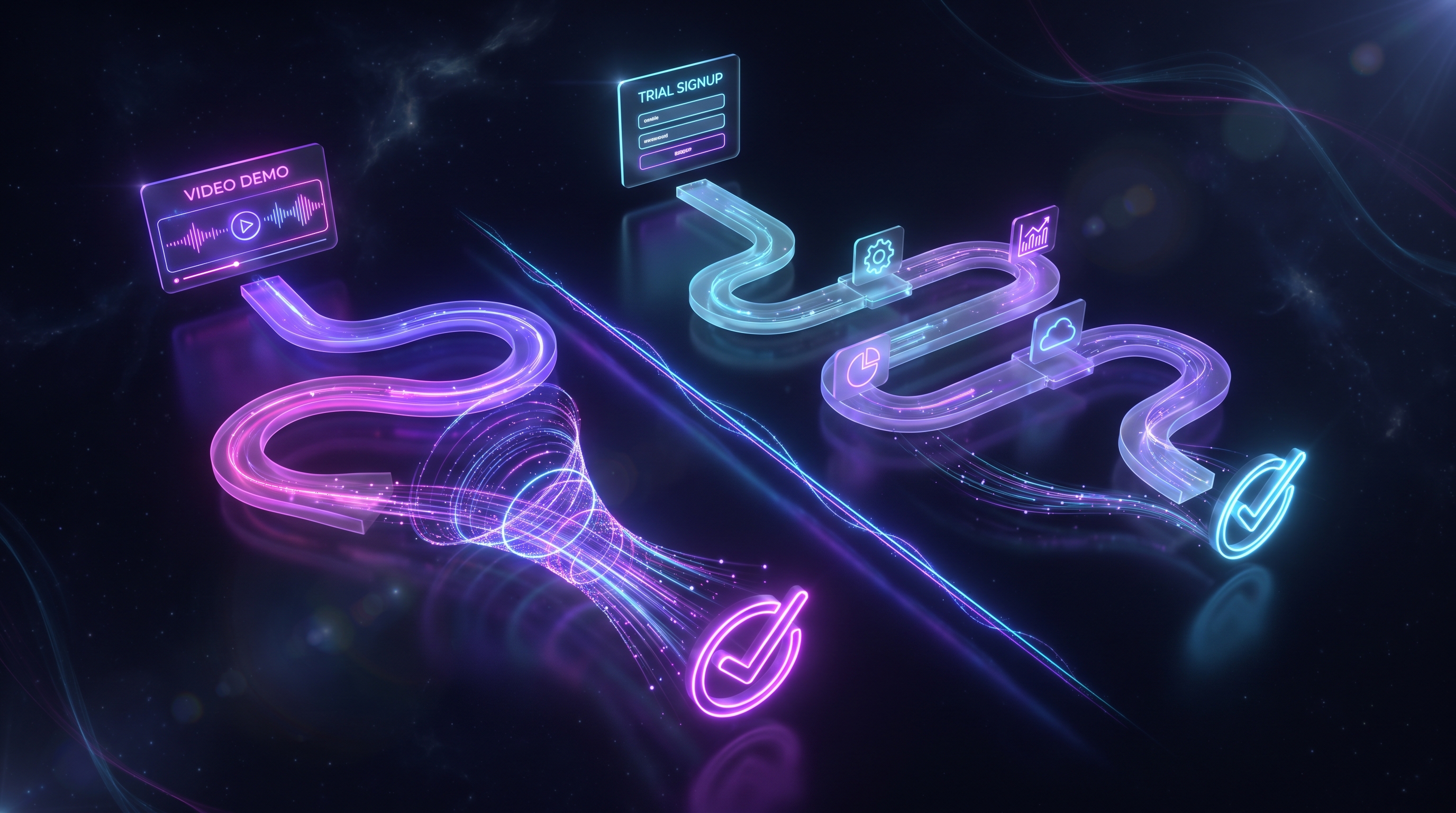
This is not the same as product-led growth (PLG), though the two share DNA. PLG requires prospects to sign up and use the product themselves. Demo-led growth makes the product experience accessible through video and interactive demos without requiring signup, login, or any friction at all. It is the "show, don't tell" philosophy applied systematically across the entire go-to-market motion — which is exactly what buyers who won't talk to sales are already demanding.
Demo-led growth is not about replacing your sales team. It is about ensuring that every prospect, customer, and stakeholder can see your product in action at the exact moment they need to, without waiting for a meeting.
Think of it this way: product-led growth says "try the product yourself." Demo-led growth says "watch the product do what you need it to do." Both are powerful. But demo-led growth has a lower barrier to entry for both the buyer and the company implementing it.
The Evolution: From Slides to Live Demos to Self-Serve Demos
To understand where demo-led growth is heading, it helps to see where we have been.
Era 1: The Sales Deck (2000-2015)
For most of the early SaaS era, the sales deck was the primary vehicle for communicating product value. Marketing created slide decks, sales reps presented them on calls, and prospects made purchasing decisions based on promises, screenshots, and competitive positioning matrices. The product itself was revealed only after a prospect had committed enough time and information to qualify for a live demonstration.
This worked when buyers had fewer options and less access to independent information. It does not work anymore.
Era 2: The Live Demo (2015-2022)
As competition increased and buyers demanded more transparency, the live demo became the centerpiece of the sales process. Sales engineers and account executives would walk prospects through the product in real time on Zoom or WebEx. This was an improvement over slides because it showed the actual product, but it had serious limitations:
- Demos required scheduling, which introduced friction and delays
- Quality varied wildly based on who was presenting
- Demos were ephemeral, available only to the people on the call at that moment
- Scaling required hiring more people, not better systems
- Prospects could not easily share the demo experience with other stakeholders
Era 3: Self-Serve Demos (2022-Present)
The current shift is toward self-serve demo content that is available on demand, without scheduling, without friction, and without a human in the loop. This includes video demos embedded on websites, interactive click-through demos, personalized demo videos sent in outreach, and demo libraries that prospects can browse independently.
This is the era of demo-led growth, and it is accelerating rapidly. The companies that master it are seeing measurable advantages in conversion rates, sales cycle length, and customer retention. For a tactical guide to implementing this, see our post on building a self-serve product demo.
Where Demos Fit in the Buyer Journey
The power of demo-led growth comes from its applicability across the entire customer lifecycle. Unlike a sales deck that serves one moment in the funnel, demo content can be deployed at every stage.
Awareness: Landing Pages and Ads
At the top of the funnel, demos serve as attention-capturing proof. A 60-second demo video on a landing page immediately communicates what your product does and how it works, far more effectively than a headline, subhead, and bullet list. Demo content in paid ads shows the actual product in action, which consistently outperforms generic brand messaging in click-through and conversion rates.
The goal at this stage is simple: show the product early, before the prospect has formed an opinion based on your copywriting alone. Let the product speak for itself.
Consideration: Comparison Pages and Email Sequences
When prospects are actively evaluating your product against alternatives, demo content becomes your strongest differentiator. On comparison pages, embedded demos let prospects see exactly how your product handles the workflows they care about. In email sequences, demo videos provide a more compelling reason to engage than another blog post or case study link.
At this stage, specificity wins. Instead of a single overview demo, you need demos tailored to specific use cases, personas, and competitive differentiators. A marketing director evaluating your product needs to see different workflows than an engineering manager, even if they are considering the same tool. Teams evaluating enterprise platforms like Walnut or Reprise often discover these tools come with significant pricing and complexity, so see our breakdowns of Walnut alternatives and Reprise alternatives.
Decision: Personalized Demos and POCs
At the decision stage, demo content complements and sometimes replaces the traditional live demo. Personalized demo videos that address a specific prospect's requirements can be shared internally with stakeholders who were not on the sales call, which is exactly what sending a demo before the first call is built to do. This solves one of the biggest friction points in B2B sales: the champion who saw the demo having to re-explain it to the decision-maker who did not.
When a prospect can forward a 3-minute demo video that shows exactly how your product solves their team's problem, the internal selling process accelerates dramatically.
Retention: Onboarding and Feature Adoption
Demo-led growth does not stop at the sale. During onboarding, demo videos that walk new users through key workflows reduce time-to-value and decrease the support burden on your customer success team. Instead of a 45-minute onboarding call, new users can watch a series of 2-minute demo videos that cover the exact features they need to learn.
For feature adoption, demo content highlights functionality that users may not have discovered on their own. Monthly "Did You Know?" demo videos showcasing underutilized features can significantly increase engagement depth and reduce churn.
Expansion: Upsell and Cross-Sell Demos
When it is time to expand an account, demo content for premium features or adjacent products eliminates the need for another round of live demonstrations. Customer success teams can send short, targeted demo videos that show the specific value the customer would unlock by upgrading. This is far more effective than a pricing table or a features list.
The SEO Case for Demo-Led Growth
One of the most compelling and underappreciated benefits of demo-led growth is its impact on search engine performance. When you create demo content for specific use cases, workflows, and competitive comparisons, you naturally generate the long-tail content that drives organic traffic.
Storylane, a company in the interactive demo space, has published notable data on this effect. Their demo-led content pages achieved a 28.8% bounce rate, compared to the industry average of approximately 70% for B2B SaaS websites. That is a dramatic difference, and it makes intuitive sense: when a visitor lands on a page that immediately shows them the product in action, they are far more likely to stay and engage than when they land on a page full of text.
Even more striking, Storylane reported pages with embedded demo content ranking in Google search results within 10 days of publication. For anyone familiar with SEO timelines, that is remarkably fast. The combination of high engagement signals (low bounce rate, long time on page, high interaction rate) and rich, unique content sends strong quality signals to search engines.
The implications for SaaS companies are significant:
- Demo pages rank faster because they generate stronger engagement signals than text-only content
- Demo pages rank for more keywords because each use-case-specific demo naturally targets long-tail search queries
- Demo pages convert better because visitors who see the product in action are more likely to take the next step
- Demo pages reduce bounce rate by providing immediate, visual value instead of asking visitors to read paragraphs of text
This creates a virtuous cycle: demo content attracts organic traffic, that traffic engages deeply, the engagement signals improve rankings, which attracts more traffic. Companies that invest in demo-led SEO are building a compounding organic growth engine.
A Framework for Implementing Demo-Led Growth
Adopting demo-led growth is not about creating one demo and embedding it on your homepage. It requires a systematic approach. Here is a four-step framework.
Step 1: Audit Your Current Touchpoints
Start by mapping every point where prospects and customers interact with your brand. For each touchpoint, document whether the visitor can see your product in action. Be honest. A screenshot is not a demo. A feature list is not a demo. Only count touchpoints where someone can watch or interact with a real product demonstration.
Common touchpoints to audit:
- Homepage and primary landing pages
- Feature and product pages
- Pricing page
- Comparison and alternative pages
- Blog posts and content hub
- Email nurture sequences
- Sales outreach templates
- Onboarding emails and in-app messaging
- Help center and knowledge base
- Customer success playbooks
- Social media profiles and content calendar
- Paid ad campaigns and landing pages
- Review site profiles (G2, Capterra, etc.)
Step 2: Identify Gaps and Prioritize
You will almost certainly find that the majority of your touchpoints lack demo content. Prioritize based on two factors: traffic volume and conversion impact. Your homepage, primary landing pages, and highest-traffic blog posts should get demos first. Then move to email sequences, sales outreach, and help documentation.
A useful prioritization matrix:
- High traffic + high conversion impact = immediate priority (homepage, pricing page, top landing pages)
- High traffic + moderate conversion impact = next wave (blog posts, comparison pages)
- Moderate traffic + high conversion impact = next wave (email sequences, sales outreach)
- Lower traffic + specific value = ongoing (help docs, onboarding, expansion)
Step 3: Create Demo Content for Each Stage
Different stages of the buyer journey require different types of demo content. Here is a content map:
Awareness demos should be 60-90 seconds, focused on the core value proposition, and designed to make the viewer want to learn more. These are not comprehensive. They are appetizers.
Consideration demos should be 2-4 minutes, focused on specific use cases and workflows. Create one for each major persona and use case. These are the workhorses of your demo library.
Decision demos should be personalized to the specific prospect or segment. Show the exact workflows, integrations, and outcomes relevant to their situation. These can be 3-5 minutes and should feel like they were made just for that buyer.
Onboarding demos should be short (60-120 seconds each), focused on a single workflow or feature, and organized in a logical learning sequence. Think of them as a video course for your product.
Expansion demos should focus on the value of features the customer is not yet using. Keep them short, outcome-focused, and easy to share internally.
Step 4: Measure and Iterate
Track these metrics to evaluate your demo-led growth strategy:
- Demo view rate: What percentage of page visitors watch the embedded demo?
- Demo completion rate: What percentage watch to the end?
- Post-demo conversion rate: What percentage take the next action (signup, book a call, start a trial) after watching?
- Demo-assisted pipeline: What percentage of qualified opportunities interacted with demo content before entering the pipeline?
- Time to close: Are deals that include demo touchpoints closing faster?
- Feature adoption rate: Are customers who watch onboarding demos adopting features faster?
- Net revenue retention: Are accounts that engage with expansion demos expanding at higher rates?
Demo Content Types for Every Channel
One of the most common mistakes in demo-led growth is treating all demo content the same. Different channels and contexts require different formats — and understanding interactive demos vs video demos is key to deploying each where it creates the most value. Here is a breakdown:
Website embeds: Autoplay-ready video demos with captions (many visitors browse without sound). Keep them concise and front-load the value. The first 10 seconds determine whether someone watches the rest.
Email demos: Thumbnail images with play buttons that link to a dedicated viewing page. Include a 1-2 sentence description of what the viewer will see. Track opens, clicks, and watch time to understand which demos resonate.
Sales outreach demos: Personalized or segment-specific videos that address the prospect's likely pain points. For a detailed playbook on using demo videos in cold email outreach, see our dedicated guide. These should feel tailored even if they are templated. Include a clear next step: "After watching, here's a link to book 15 minutes to discuss how this applies to your team."
Social media demos: 30-60 second clips optimized for the platform (square for Instagram, vertical for TikTok/Reels, landscape for LinkedIn/YouTube). Lead with the outcome, not the setup. Social audiences decide in 2-3 seconds whether to keep watching.
Help center demos: Step-by-step walkthrough videos embedded alongside text documentation. One video per article. Focus on the specific task described in the article, not a broad product overview.
Internal demos: Product demos for internal stakeholders (investors, board members, cross-functional partners) that tell the product story without requiring deep context. These are often overlooked but high-impact.
Why AI Is Essential for Scalable Demo-Led Growth
Here is the challenge with demo-led growth: the strategy demands a lot of content. If you follow the framework above, you might need dozens or even hundreds of demo videos across different personas, use cases, lifecycle stages, and channels. And all of them need to stay current as your product evolves.
This is where most companies stall. The strategy makes sense. The data supports it. But the production capacity is not there. Creating demo videos manually takes 4-8 hours per video, and the true cost of product demo videos is even higher when you include maintenance. A team that needs 50 demos is looking at 200-400 hours of production work just for the initial library, before accounting for updates. Scaling demo production without growing your team is one of the central challenges of executing this strategy effectively.
The math simply does not work with manual production. And that is exactly why AI demo video generators are so transformative for demo-led growth.
Demo-led growth is the right strategy. AI is what makes it executable. Without automated demo production, most companies cannot create enough content to implement demo-led growth at scale.
Tools like Demosmith change the equation entirely. Instead of 4-8 hours per demo, you can produce a polished, branded demo video in under 10 minutes. Paste your product URL, describe the workflow, and Demosmith's AI agent autonomously navigates your product, captures the interaction, applies smart editing, generates voiceover narration in any of 10 supported languages, adds dynamic captions, applies your brand kit, and outputs a finished MP4 with a shareable link.
That means the 50-demo library that would take 200-400 hours of manual work can be produced in a single day. More importantly, when your product ships an update and 15 of those demos need to be refreshed, you can regenerate them in an afternoon instead of burning a week of production time.
This is what makes demo-led growth practical. The strategy only works at scale if the production bottleneck is removed. AI demo agents remove it.
Getting Started with Demo-Led Growth
You do not need to overhaul your entire go-to-market strategy overnight. Demo-led growth can be adopted incrementally, and the impact is visible quickly.
Week 1: Quick wins. Add a demo video to your homepage and your highest-traffic landing page. If you do not have one, create a 60-90 second overview demo using an AI demo agent. Measure the impact on bounce rate and conversion rate.
Week 2-3: Email integration. Add demo videos to your top-performing email sequences. Test demo thumbnails against your current CTAs. Track click-through rate and downstream conversion.
Week 4: Sales enablement. Create 3-5 persona-specific demo videos and equip your sales team to include them in outreach. Measure response rate and meeting booking rate for emails with demos versus without.
Month 2: Expand coverage. Use the touchpoint audit framework to identify the next wave of opportunities. Build out use-case-specific demos for your comparison pages, help center, and onboarding flow.
Month 3: Measure and scale. Analyze the data from your first 8 weeks. Identify which demo placements drove the most impact. Double down on what works and expand your demo library to cover more personas, features, and use cases.
The companies that adopt demo-led growth early are building a structural advantage. Every demo video is a compounding asset: it generates traffic, captures attention, accelerates decisions, improves retention, and enables expansion. The sooner you start building that library, the wider the gap between you and competitors still leading with slide decks. The most efficient teams record once and publish everywhere, turning a single demo into video, docs, PDF, and HTML from one production pass.
The sales deck had a good run. But the future of SaaS go-to-market is demo-led. For a detailed implementation guide, see our video-first demo-led growth playbook covering full-funnel strategy, YouTube SEO, and production workflows. For the product teams, marketers, and sales leaders ready to make the shift, the tools and the playbook are ready now.