Why Teams Are Looking Beyond Tourial
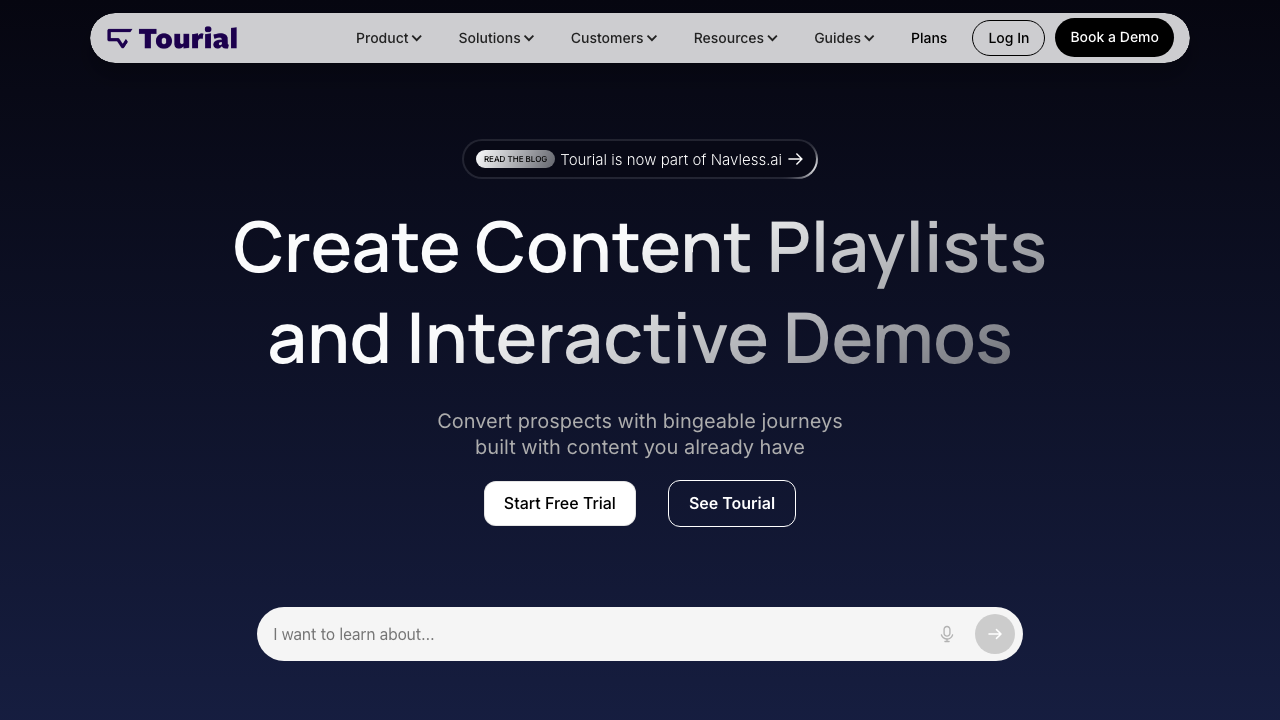
Tourial has carved out a niche in the interactive demo market with its "Micro Tours" and Demo Centers. If you have been evaluating tools to give prospects a self-serve product experience, Tourial has probably appeared on your shortlist. The platform lets marketing and sales teams build guided product tours using a Chrome extension, then organise those tours into multi-flow Demo Centers that prospects can browse by use case, persona, or feature.
The problem is straightforward: Tourial starts at $1,000 per month on a mandatory annual contract. That is $12,000 per year minimum, with no free plan, no free trial, and no month-to-month option. For a company with 14 employees and roughly $1.8M in revenue, that is enterprise-level pricing for a product that still requires manual Chrome extension capture and produces interactive output only.
If you are reading this, you have likely run into one of two situations. Either Tourial's pricing exceeds your budget for a demo tool, or you need video output (MP4 files, YouTube content, sales deck assets) that Tourial simply does not produce. Many teams face the two issues at once.
This guide covers what Tourial does well, where it falls short, and the best alternatives for teams that need AI-powered demo video generators rather than interactive click-through tours. We will give Tourial credit where it is earned, then walk through tools that solve the video problem at a fraction of the cost.
What Tourial Does Well
Tourial is not a bad product. It is a specialised one. Here is what it brings to the table for teams whose needs align with its approach.
Micro Tours
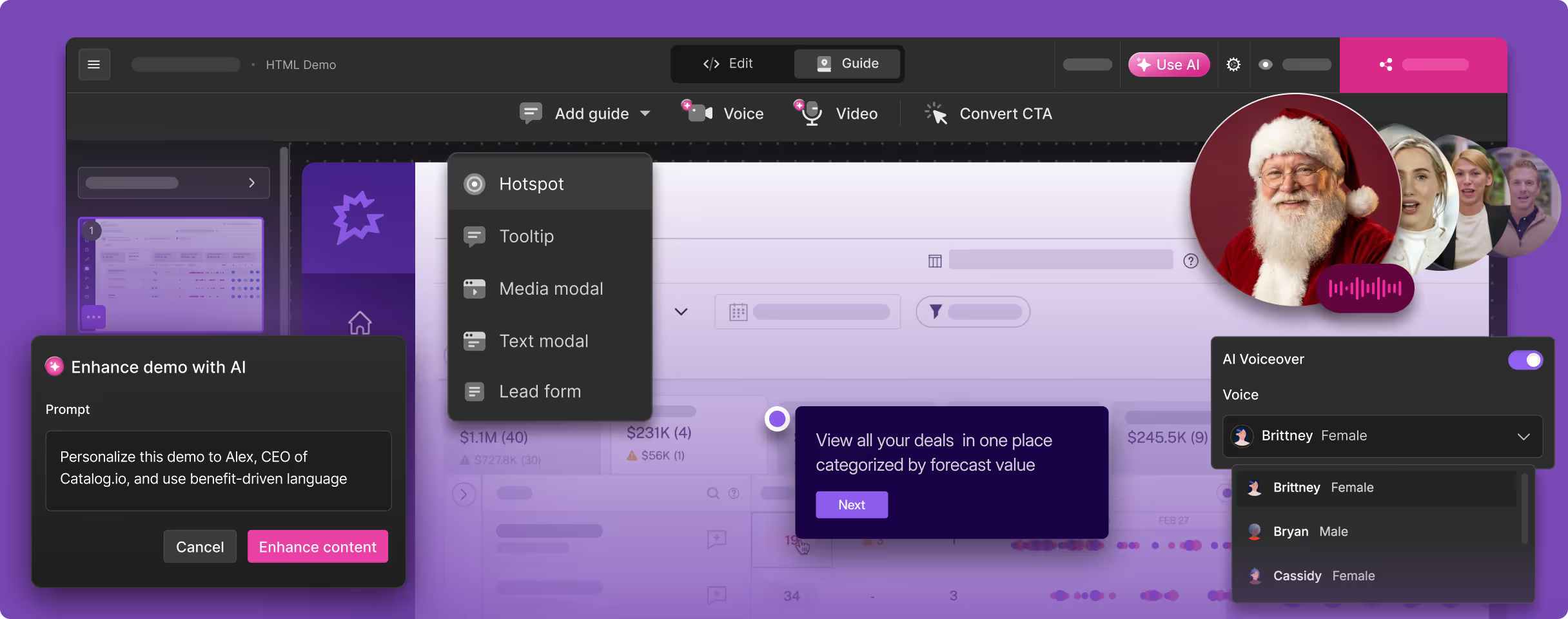
Tourial's signature feature is the Micro Tour: a short, focused interactive walkthrough that covers a single feature or workflow. The idea is sound. Instead of building one massive product tour that tries to cover everything, you build dozens of targeted Micro Tours that each address a specific question or use case. A prospect interested in your reporting feature watches the reporting Micro Tour. A prospect interested in integrations watches the integrations Micro Tour.
This modular approach aligns well with how buyers actually evaluate products. People rarely want to see everything at once. They want to see the parts that matter to them.
Demo Centers
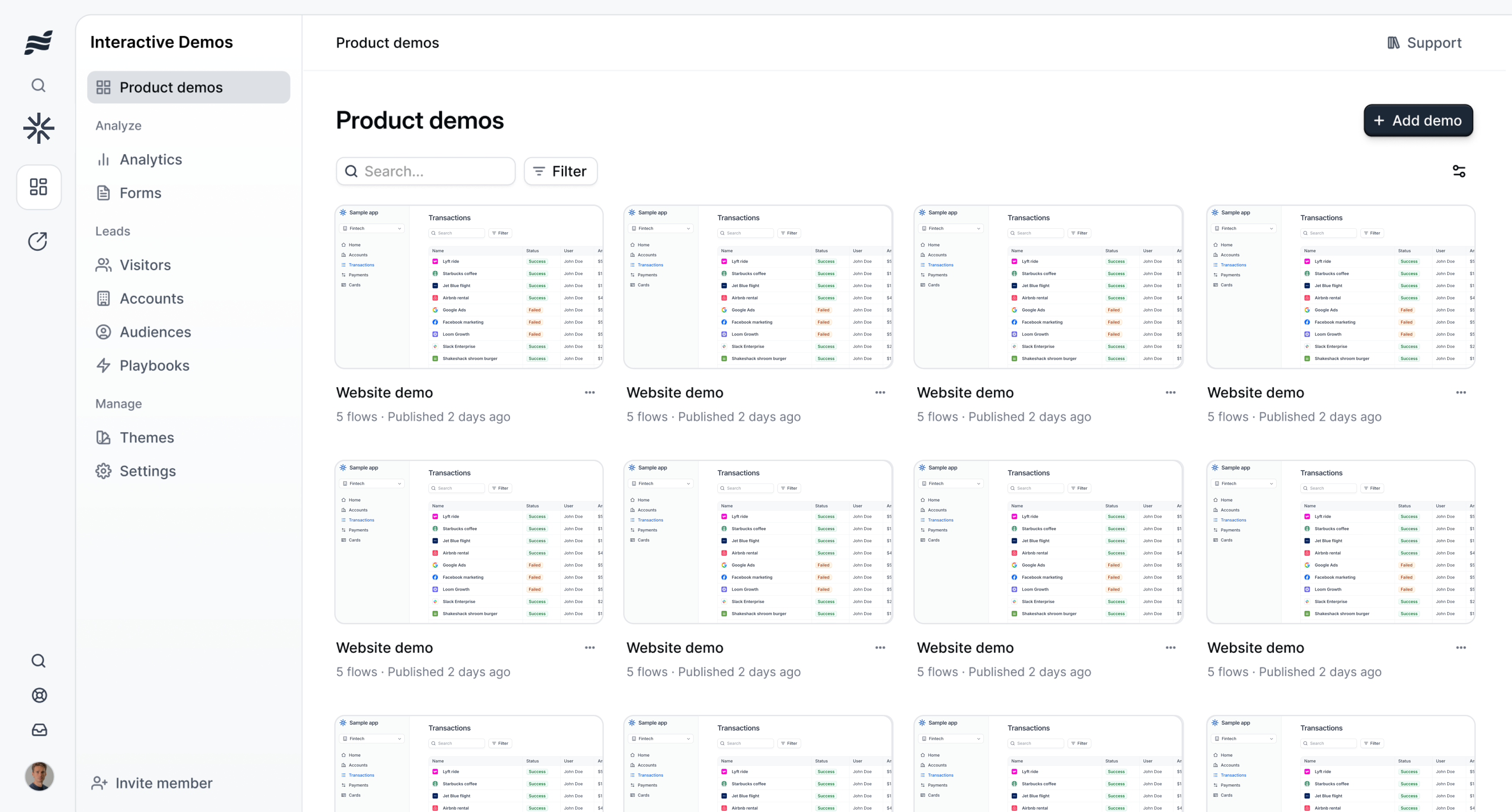
Demo Centers are Tourial's way of organising Micro Tours into a browsable library. You create a landing page where prospects can self-select based on their role, use case, or the feature they want to explore. The Demo Center surfaces the relevant Micro Tours based on that selection.
For marketing teams, this is a useful content organisation tool. Instead of embedding a single demo on your website, you offer a curated collection that adapts to the viewer's interests. The experience mimics a well-organised resource centre, but for interactive product demos rather than blog posts or whitepapers.
Chrome Extension Capture
Like most interactive demo tools, Tourial uses a Chrome extension to capture your product screens. You navigate through your application, and the extension records each step. The process is familiar to anyone who has used Storylane, Navattic, or Arcade. You then build your tour in Tourial's editor, adding tooltips, annotations, and guided paths.
The capture process works as expected. Non-technical team members can build tours without engineering support, which lowers the barrier to getting demos published.
AI Tour Generation
Tourial has introduced AI-assisted tour creation that helps generate annotations and descriptions based on the captured screens. This speeds up the authoring process and reduces the amount of manual tooltip writing required. You still need to capture the screens yourself and review the AI-generated content, but the starting point saves time compared to writing every annotation from scratch.
Analytics with Buying Signals
Tourial's analytics go beyond basic view counts. The platform tracks which tours prospects engage with, how far they progress, and where they spend the most time. Tourial frames these interactions as "buying signals" that help sales teams prioritise follow-up. If a prospect spent three minutes exploring your API integration Micro Tour, that tells the sales rep something about the prospect's priorities before the first call.
CRM and Marketing Integrations
Tourial integrates with HubSpot, Marketo, Salesforce, and other go-to-market tools. Demo engagement data flows into your CRM, enabling lead scoring based on demo interaction and automated workflows triggered by specific viewing behaviours. For enterprise sales teams, these integrations connect the demo experience to the rest of the sales process.
Purpose-Built for Marketing-Led Demo Experiences
Tourial positions itself squarely in the marketing demo category. Demo Centers on your website, Micro Tours in email nurture sequences, interactive experiences for prospects who are not ready to talk to sales. If your primary use case is giving marketing-qualified leads a self-serve way to explore your product, Tourial's feature set is built for that job.
Where Tourial Falls Short for Video Demos
Tourial's strengths are clear, but so are its limitations. For teams that need video output or that find Tourial's pricing unjustifiable, these gaps are significant.
Enterprise Pricing Without Enterprise Scale
Tourial's Engage plan starts at $1,000 per month with a mandatory annual contract. The Scale plan (unlimited seats and tour centres) is custom-priced but reportedly higher. There is no free plan, no free trial, and no monthly billing option. You commit to $12,000 or more before you have built a single tour.
For a company with roughly 14 employees and $1.8M in estimated revenue, this pricing creates a risk asymmetry. You are paying enterprise rates for a tool built by a very early-stage startup. That is not inherently disqualifying, but it is worth weighing against alternatives that offer free trials, monthly billing, and lower entry points.
Interactive Output Only, No Video
Tourial's output is interactive click-through tours. There is no video export, no MP4 output, and no way to produce a video demo from the platform. If you need content for YouTube, LinkedIn, sales decks, email outreach, conference displays, or any other channel that requires video, Tourial cannot help.
This is the same fundamental limitation shared by most interactive demo tools. But combined with Tourial's pricing, the constraint feels more acute. At $12,000 per year, you get a tool that covers only part of your demo needs. You still need a separate tool and a separate budget for video demos.
No AI Voiceover or Audio Capabilities
Interactive tours do not need narration. Viewers read tooltips and click through at their own pace. But for every context where you need video, voiceover narration is essential. A silent product video does not hold attention and does not convert. Tourial has no voiceover features, no text-to-speech, and no audio capabilities of any kind.
Manual Capture Remains a Bottleneck
Despite the AI tour generation features, Tourial still requires manual Chrome extension capture for every tour. Someone on your team navigates the product, the extension captures each screen, and you build the tour from those captured screens. When your product UI changes, you re-capture the affected screens and update each tour manually.
For teams producing a handful of tours, this is manageable. For teams that need to maintain a library of demos across multiple features, personas, and languages, the manual capture requirement scales linearly with the size of your demo library.
Annual Lock-in with No Trial
Most SaaS tools in 2026 offer some combination of free tier, free trial, or monthly billing. Tourial offers none. You sign an annual contract before you have confirmed the tool works for your specific use case. This makes evaluation difficult. You cannot test it alongside other tools in your stack. You cannot run a pilot with one team before rolling it out company-wide. You commit, or you do not.
Small Team, Platform Risk
Tourial has raised $5.4M in seed funding from Bonfire Ventures and has approximately 14 employees. In the interactive demo space, it competes against Navattic, Storylane, Arcade, and others that have raised more capital and built larger teams. For buyers evaluating long-term platform bets, the size of the team and the stage of the company are legitimate factors. A small team can ship fast, but it also means fewer resources for support, stability, and feature development.
What to Look For in a Tourial Alternative for Video Demos
If you have determined that Tourial's pricing does not justify the value for your team, or that you need video output rather than interactive tours, here are the criteria that matter when evaluating alternatives.
Video as the Primary Output
The alternative should produce video as its core output format: downloadable MP4 files, shareable video links, and embeddable players. Video should not be a secondary export option. When video is the primary output, the entire product experience is optimised for video quality, from capture to editing to voiceover to export.
AI Voiceover with Multi-Language Support
Professional demo videos need narration. The best tools generate AI voiceover that sounds natural, supports multiple languages, and synchronises with the visual flow. If your company sells internationally, multi-language voiceover should be built in, not require separate voiceover artists for each language.
Autonomous or Minimal-Effort Capture
The biggest time cost in demo creation is the capture step. Whether you record your screen or click through a Chrome extension, you are manually driving the process. The best modern tools reduce or eliminate this step using AI agents that navigate your product from a URL and a text prompt.
Accessible Pricing Without Annual Lock-in
At $12,000 per year with no free plan and no trial, Tourial is an outlier in its pricing approach. Look for alternatives that offer free trials, monthly billing, and pricing that starts well below $1,000 per month. The ability to evaluate a tool before committing significant budget is table stakes in 2026.
Professional Editing Built In
Raw screen captures are not finished demos. Professional demo videos include transitions, zoom effects, captions, and consistent branding. The right alternative handles this editing automatically. You should not need to take the output into a separate video editor to make it presentable.
Best Tourial Alternatives for Product Demo Videos
1. Demosmith -- Best Overall Tourial Alternative for Video Demos
Demosmith is the most direct alternative for teams leaving Tourial over either pricing or the lack of video output. It is an AI Demo Agent: a fundamentally different category than Tourial. Where Tourial captures screenshots via Chrome extension and builds interactive Micro Tours, Demosmith autonomously navigates your product and produces polished video demos with AI voiceover, professional editing, and brand customisation.
The workflow replaces the capture step and the editing step in one pass. You paste your product URL into Demosmith. You describe the flow you want demonstrated in plain English: "Show how a marketing team creates a campaign, sets up audience targeting, and launches." The AI agent opens your product in a cloud browser, navigates the flow autonomously, captures the screens, and auto-edits the footage with transitions, zoom effects, synchronised captions, and AI voiceover narration.
The output is a polished MP4 video plus a shareable link. Turnaround is under 10 minutes. No Chrome extension. No manual clicking. No annual contract.
Where Demosmith beats Tourial:
- Video output. Every demo Demosmith generates is a purpose-built MP4: professional production quality that works on YouTube, LinkedIn, in sales decks, email sequences, and every other channel where video is the required format. Since September 2026, the same recording can also be compiled into an interactive, clickable walkthrough.
- AI voiceover in 29 languages. Tourial has no audio capabilities. Demosmith generates natural-sounding narration in 29 languages, synchronised to the demo flow. For international teams, one prompt produces one video, and regenerating in another language takes minutes.
- Autonomous capture. No Chrome extension, no manual clicking, no screenshot management. Demosmith's AI agent handles the entire capture process from a URL and a text prompt.
- Pricing that makes sense. Demosmith Starter is $40 per month. Tourial Engage is $1,000 per month. That is a 25x difference at the entry tier. Demosmith offers a free trial with no credit card required. Tourial offers neither a trial nor a free plan.
- No annual lock-in. Demosmith bills monthly. Cancel any time. You do not sign a contract before confirming the tool works for your team.
- Brand kit auto-applied. Configure your colours, logo, fonts, and intro/outro once. Every video matches your brand identity automatically.
- Lower maintenance burden. When your UI changes, regenerate the demo by running the same prompt. No screen-by-screen recapture. No tooltip repositioning.
Pricing: Free trial available. Starter at $40/mo, Pro at $99/mo, Business at $250/mo, Enterprise custom.
Limitations:
- Updated September 2026: Demosmith also compiles interactive demos from its own recordings of your product, so website click-through tours no longer require a separate tool.
- Complex flows involving third-party authentication or multi-service integrations may require a second generation pass or manual guidance.
- Frame-by-frame editing control is more limited than a traditional video editor, though auto-editing is sufficient for most demo use cases.
Best for: Teams leaving Tourial over pricing, teams that need video output for marketing and sales, and teams that want to produce demo content without a $12,000 annual commitment. Particularly strong for international teams that need multilingual demos.
See the AI demo video generator page for the full workflow.
Tourial charges $12,000 per year for interactive click-throughs built with a Chrome extension. Demosmith charges $480 per year for autonomous video demos built from a URL. The output format is different, and so is the value equation.
2. Storylane -- Interactive Demo Builder at a Lower Price
If your primary need is interactive demos rather than video, Storylane is the most direct Tourial competitor with a significantly lower entry point. Storylane offers the same core functionality: Chrome extension capture, guided product tours, analytics, and CRM integrations. But it does so with a free tier, a $40/mo Starter plan for screenshot-based demos, and a $500/mo Growth plan for HTML capture.
Storylane's HTML capture is genuinely impressive. It clones your application's front-end code, creating near-perfect replicas where form fields are editable and dropdowns work. This creates a more authentic experience than screenshot-based tours. The platform also supports AI-generated annotations, branching logic, and detailed analytics.
Pricing: Free tier available. Starter at $40/mo. Growth at $500/mo. Enterprise custom.
Where Storylane beats Tourial:
- Free tier and $40/mo entry point vs Tourial's $1,000/mo minimum.
- HTML capture on the Growth plan creates more authentic interactive experiences.
- Larger user base, more mature platform, and stronger market position in the interactive demo category.
- Monthly billing available on lower tiers.
Limitations:
- Still interactive-only output. No video, no voiceover, no MP4 export.
- Manual Chrome extension capture required for every demo.
- HTML capture locked behind the $500/mo Growth plan.
Best for: Teams that specifically need interactive demos at a lower price than Tourial. Not a video demo tool.
3. Arcade -- Interactive Demos with Video Export
Arcade occupies interesting middle ground. Like Tourial, it is primarily an interactive demo builder with Chrome extension capture, guided walkthroughs, and branching paths. Unlike Tourial, Arcade has invested in video export as a secondary output format and offers a functional free plan.
The branching paths feature is a standout. You create persona-specific demo experiences where a prospect who selects "developer" sees a different flow than one who selects "product manager." For teams that want tailored demo experiences on their website, this is a useful capability that Tourial's Micro Tours approach does not replicate as cleanly.
Arcade's video export gives it flexibility that Tourial lacks entirely. You build an interactive demo and can export it as a video file for channels where interactive format does not work. The exported video is a recording of the interactive experience rather than a purpose-built video, so it lacks professional editing, but it covers basic video needs.
Pricing: Free plan available. Pro at $32/mo per user. Team and Enterprise tiers available.
Where Arcade beats Tourial:
- Free plan and $32/user/mo entry point vs Tourial's $1,000/mo annual commitment.
- Video export provides distribution flexibility that Tourial does not offer at all.
- Branching paths for persona-specific demos are more flexible than Micro Tours.
Limitations:
- Video export is secondary. The output is a recording of the interactive experience, not a purpose-built video with cinematic editing.
- No AI voiceover. Exported videos are silent unless you add audio externally.
- Per-user pricing means costs scale with team size.
- Manual Chrome extension capture required.
Best for: Teams who need interactive demos with occasional video export, at a fraction of Tourial's cost.
4. Supademo -- Budget-Friendly Interactive Demos
Supademo takes the interactive demo concept and makes it as affordable as possible. At $27 per month for the Pro plan, it is one of the least expensive options in the category. The Chrome extension captures your product screens, and AI auto-generates annotations and descriptions for each step.
Supademo does not try to compete with Tourial on enterprise features. There are no Demo Centers, no advanced buying signal analytics, and no deep CRM integrations at the lower tiers. What Supademo offers is speed and simplicity: capture your screens, let the AI generate the tour content, review, publish. For teams that need basic interactive demos without the overhead of an enterprise platform, it gets the job done.
Pricing: Free plan available. Pro at $27/mo. Scale at $38/mo. Enterprise custom.
Where Supademo beats Tourial:
- $27/mo vs $1,000/mo. The price difference is hard to ignore.
- Free plan for evaluation.
- AI-generated annotations speed up tour creation.
- Simpler to learn and deploy.
Limitations:
- Screenshot-based only. No HTML capture.
- No video export, voiceover, or video editing.
- Limited analytics and enterprise features compared to Tourial.
- Not suited for large-scale enterprise demo programmes.
Best for: Startups and small teams that need basic interactive demos at the lowest possible cost.
Interactive Demos vs Video Demos: Why the Format Matters
The Tourial alternative you choose depends entirely on what format your distribution channels require. Interactive demos and video demos are not interchangeable. They serve different audiences, different channels, and different moments in the buyer journey.
When Interactive Demos Win
Interactive demos perform best when the viewer has intent and attention. A prospect on your website clicks "See the product" and wants to explore at their own pace. A buyer in a nurture sequence clicks through a guided tour that covers the specific feature they asked about. A customer success team embeds step-by-step walkthroughs in a help centre.
In these contexts, the click-through format is a strength. The viewer controls the pace. They can skip sections that do not apply to them. They can go deep on the parts that matter. Tourial, Storylane, Arcade, and Supademo all serve this use case well, and for a broader view of how the interactive demo landscape compares, those tools each have distinct strengths.
When Video Demos Win
Video demos are essential for every context where the viewer is passive, where they are watching rather than clicking:
- YouTube and video SEO. You cannot upload an interactive tour to YouTube.
- Social media. Native video posts on LinkedIn and Twitter get dramatically higher engagement than links to external interactive demos.
- Sales emails and outreach. A video thumbnail in an email gets significantly more clicks than a text link to a tour.
- Sales decks and presentations. A polished demo video plays within Google Slides or PowerPoint. An interactive tour breaks the flow.
- Conference booths and events. Screens at trade shows play video on loop.
- Paid advertising. Video ads on LinkedIn, YouTube, and Meta all require video.
In all of these contexts, interactive demos either do not work at all or work poorly compared to video. If these channels matter to your go-to-market motion, you need a video tool.
The Practical Approach: Use Both
The smartest teams use interactive demos for on-site exploration and video demos for every other channel. Storylane or Supademo for website embeds. Demosmith for YouTube, social, email, sales decks, and events. The combined cost of Storylane Starter ($40/mo) plus Demosmith Starter ($40/mo) is $80 per month, less than one-twelfth of Tourial's annual commitment, and it covers interactive and video output.
Tourial vs Alternatives: Side-by-Side Comparison
Here is how Tourial stacks up against the best alternatives across the dimensions that matter most:
| Feature | Tourial | Demosmith | Storylane | Arcade |
|---|---|---|---|---|
| Primary Output | Interactive Micro Tours | MP4 video + shareable link | Interactive click-through | Interactive + optional video |
| Video Export | No | Yes, primary output | Limited | Yes, secondary |
| AI Voiceover | No | Yes, 29 languages | No | No |
| Autonomous Capture | No, Chrome extension | Yes, AI agent navigates | No, Chrome extension | No, Chrome extension |
| Free Plan or Trial | No | Free trial, no credit card | Free tier available | Free plan available |
| Starting Price | $1,000/mo (annual only) | $40/mo (Starter) | $40/mo (Starter) | $32/user/mo (Pro) |
| Annual Commitment | Mandatory | No, month-to-month | Monthly available | Monthly available |
| Multi-Language | UI text only | 29 languages with voiceover | UI text only | Limited |
| Best For | Marketing-led interactive demos | Video demos for all channels | Website-embedded interactive tours | Interactive + occasional video |
Conclusion: Choosing the Right Tourial Alternative
Tourial has built a focused product for marketing-led interactive demos. The Micro Tours concept is smart. Demo Centers provide a useful way to organise product content for self-serve buyers. And the analytics with buying signals add genuine value for sales teams that want to prioritise outreach based on prospect behaviour.
But the pricing is hard to justify for most teams. $12,000 per year with mandatory annual contracts, no free plan, and no trial puts Tourial in a category where the cost needs to be matched by irreplaceable value. For many teams, it is not. Storylane and Arcade offer comparable interactive demo capabilities at a fraction of the price. Supademo offers basic interactive demos for less than $30 per month.
And if your primary need is video output, Tourial is the wrong tool entirely. It does not produce video. It has no voiceover capabilities. It cannot generate content for YouTube, social media, sales decks, or any channel that requires video format.
Demosmith fills the video gap. Its AI Demo Agent produces polished demo videos from a URL and a text prompt, with voiceover in 29 languages, professional editing, and brand customisation. The Starter plan costs $40 per month. There is a free trial with no credit card required. No annual contract.
For many teams, the right answer is to pair an affordable interactive tool (Storylane at $40/mo or Supademo at $27/mo) with Demosmith for video ($40/mo). That gives you interactive demos for your website and video demos for every other channel, at a total cost that is less than one month of Tourial.
The question is not whether Tourial's Micro Tours are useful. They are. The question is whether they are $12,000-per-year useful when alternatives cover the same ground for $40 per month, and video tools cover the ground Tourial does not touch at all.
Key Takeaways
- Tourial starts at $1,000 per month with mandatory annual contracts. No free plan, no trial. Alternatives start at $27 to $40 per month with free tiers and monthly billing.
- Tourial produces interactive click-through tours only. It has no video output, no voiceover, and no MP4 export. For teams that need video demos, it is the wrong category of tool.
- Demosmith is the strongest alternative for video output. Its AI Demo Agent produces polished demo videos autonomously from a URL, with voiceover in 29 languages, starting at $40 per month.
- Storylane and Arcade offer comparable interactive demo capabilities to Tourial at significantly lower price points, with free plans and monthly billing available.
- The most cost-effective approach for most teams is to combine an interactive tool (Storylane at $40/mo) with a video tool (Demosmith at $40/mo) for $80/mo total, covering the two formats for less than one month of Tourial.
- Tourial's small team size (14 employees) and early-stage funding ($5.4M seed) are factors worth considering when evaluating long-term platform commitment at enterprise pricing.