Most teams ask the wrong question about demo videos. They obsess over optimal length and debate whether two minutes is better than four. But the more important question is what happens when you get it wrong. How fast do you lose someone? When do they make the decision to leave? And what did they actually see before they clicked away?
The data on this is specific and somewhat uncomfortable. Prospects do not give you the benefit of the doubt. They do not wait to see if the demo improves. They make a leave decision in the first 30 to 60 seconds, and once they are gone, they are gone. Every second you spend on context-setting, introductions, and feature walkthroughs before showing value is a conversion you are leaving behind.
This post is the companion to our guide on how long your demo video should be. That post covers optimal length. This one covers what the drop-off data actually shows, and why the consequences of getting attention wrong are worse than most teams realise.
The attention span problem: what the data actually shows
Microsoft research found that the average human attention span has dropped to 8 seconds, down from 12 seconds in 2000. That is shorter than a goldfish, the comparison that every journalist reaches for. But the more relevant framing for SaaS teams is this: you have roughly 8 seconds to signal to a prospect that this video is worth their time before their brain starts looking for the exit.
That window is not long enough to explain your product. It is barely long enough to name the problem you solve. The implication is that demo videos need to be structured completely differently from how most teams build them. The instinct is to set up context first, explain what the product is, then show the value. The data says that approach loses a third of your audience before you get to anything useful.
The good news is that 85% of B2B SaaS prospects who watch product videos are more likely to buy, according to Aimers research. The attention is there. The intent is there. The gap is execution.
When do prospects decide to leave? The 30-second cliff
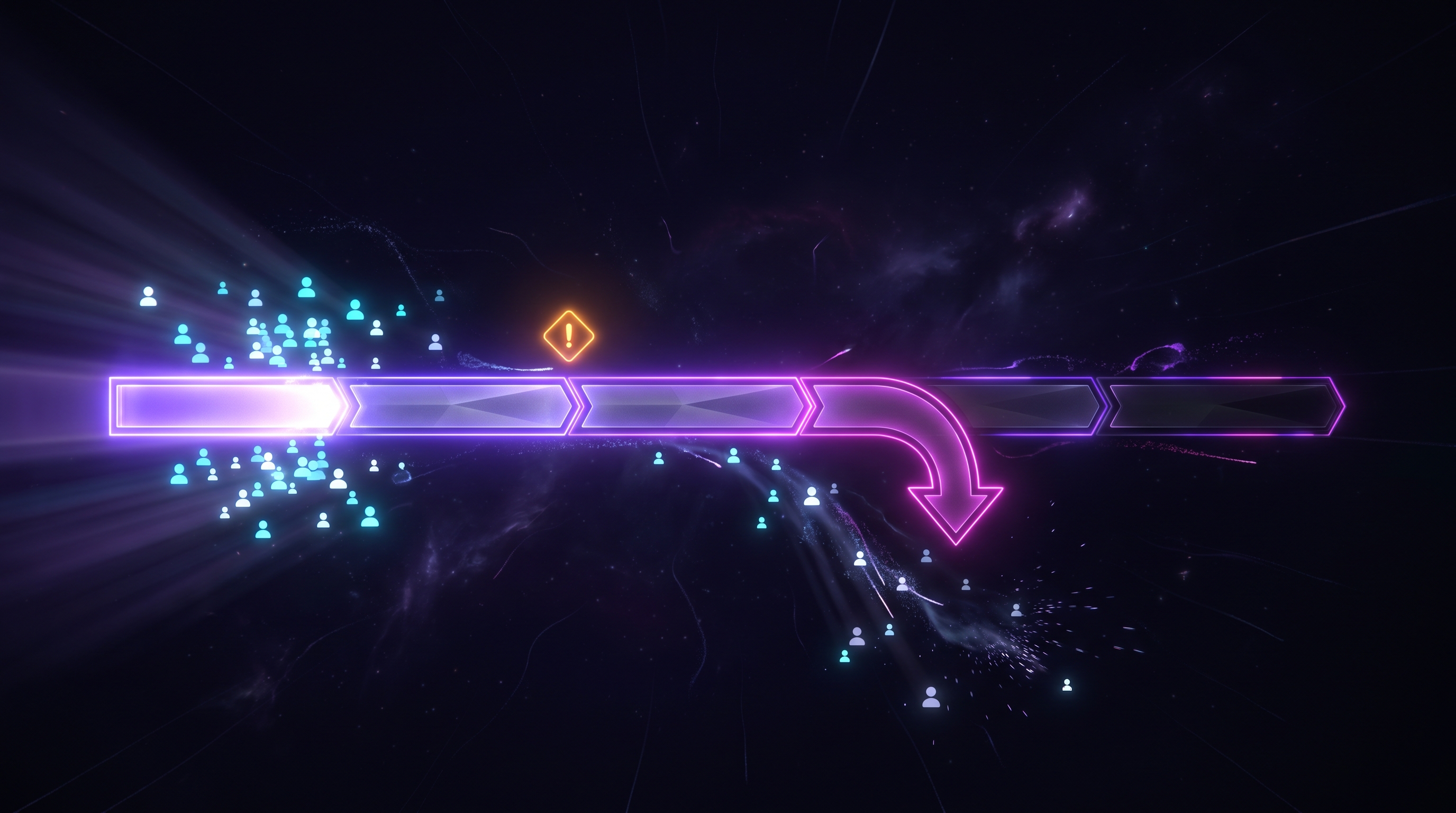
Autodemo data shows that 33% of viewers stop watching by the 30-second mark. Not at the end. Not halfway through. In the first half-minute.
This is not a fringe group of disengaged visitors who were never going to convert. These are people who found your demo, clicked play, and watched for up to 30 seconds before deciding it was not worth continuing. The drop-off is not random. It is almost always triggered by one of two things: the video did not show value quickly enough, or the production quality made it hard to stay engaged.
The 30-second cliff also matters because of where prospects are in the buying process when they find your demo. Research from Consensus shows that prospects have already completed 60% of their buying decision before they talk to sales. They are not watching your demo cold. They are comparing you to one or two other options, looking for confirmation that you can solve their specific problem. A generic 30-second intro about your company is not that confirmation.
By the time a prospect clicks play on your demo, they have already done most of their research. The demo is not the discovery moment. It is the confirmation moment. Get to the point.
What happens after 60 seconds? The drop-off curve by length
The viewers who make it past 30 seconds are not safe. Drop-off continues throughout, but the rate slows considerably for people who have seen enough to stay engaged. Wistia's data shows that videos under 1 minute achieve around 65% average engagement across their entire runtime. That is the sweet spot for retention.
Extend the video to 2 to 3 minutes and engagement holds reasonably well for viewers who opted in with some intent, but it falls off faster for cold or low-intent traffic. Vidyard's benchmark data (via Rally) shows that about 50% of people finish videos under 10 minutes. That sounds like a high bar until you consider that the other 50% left before the end, which in a 10-minute video might mean leaving at the 5-minute mark with major capabilities still unseen.
The pattern across every data source is consistent. Engagement decays over time, but the steepest drop happens in the first 30 to 60 seconds. Viewers who survive that window are much more likely to finish. The critical investment is front-loading value, not shortening the video indiscriminately.
There is also a timing dimension that does not get enough attention. ZoomInfo data shows that demo completion rates peak at 10 to 11am, at 63%. Send your demo at 2pm on a Friday and the same content performs differently, not because the video changed but because the viewer's attention did.
How long should your demo be? Optimal length by use case
Length is not a single variable. The right answer depends entirely on where the demo lives, who is watching, and what they already know about you when they press play. The table below covers the five most common use cases and the data-backed length range for each.
| Use Case | Recommended Length | Why |
|---|---|---|
| Homepage hero | 60–90 seconds | Attention is lowest, intent is broadest. Get to the core value prop fast. |
| Cold outreach email | 30–60 seconds | No context, no trust yet. Show one problem solved. Nothing more. |
| Sales leave-behind | 2–3 minutes | Prospect opted in, has more patience. Can cover multiple use cases. |
| Onboarding demo | 3–5 minutes | User already committed. Wants depth, context, and next steps. |
| Full product walkthrough | 5–10 minutes | Requested by technical evaluators. Completeness matters here. |
The pattern across these use cases is that length should track with how much the viewer already trusts you and how much intent they bring to the viewing. A cold prospect watching a homepage hero video has minimal trust and broad intent. A technical evaluator requesting a full walkthrough has built up enough interest to justify sitting through 10 minutes.
The 73% of marketers who told ngram that 30 seconds to 2 minutes is the most effective video length are probably thinking about cold and mid-funnel contexts. That guidance does not apply uniformly to a demo sent to someone who asked for it after a discovery call.
For a full breakdown of how to calibrate length across every stage of the buyer journey, see our guide on best SaaS demo video examples, which covers what high-performing videos in each category actually look like.
Why personalised demos get 63% higher completion
YouTube benchmark data shows that demos personalised by persona or use case achieve 63% higher completion rates than generic ones. That is not a small edge. That is the difference between a demo most people abandon and one most people finish.
A generic demo has to appeal to everyone, which means it prioritises breadth over relevance. A viewer watching a generic demo has to mentally translate what they are seeing into their specific context. That cognitive load is friction, and friction causes drop-off.
A demo built for a specific persona, say, a head of sales watching a clip about CRM integration, does not require that translation. The viewer sees their exact situation reflected back at them. The relevance is immediate, and the completion rate reflects that.
The challenge is that personalising demos at scale used to be prohibitively expensive. Recording a separate version for each persona meant booking studio time or a content creator's day, writing new scripts, re-recording, and re-editing for each variant. Most teams could not justify the investment, so they settled for one generic demo sent to everyone.
That constraint has changed. An AI demo agent can generate persona-specific videos in minutes. Describe the use case, adjust the flow, and the agent produces a finished video tailored to that audience without re-recording anything manually. The marginal cost of an additional persona variant approaches zero, which means the 63% completion rate uplift is now accessible to teams of any size.
The five things that kill your completion rate
Most demo drop-off is preventable. These are the five patterns that consistently cost teams viewers.
1. No hook in the first 10 seconds. If the viewer does not understand what problem you solve within the first 10 seconds, their attention starts to wander. The instinct is to warm up slowly with a logo animation, a brief company overview, or context about the market. Cut all of it. State the problem you solve in the first sentence. Everything else can come after.
2. Unedited screen recordings. Raw screen recordings have slow mouse movements, pauses where things load, and no visual emphasis on what matters. They are hard to watch even for someone who is genuinely interested. Zoom effects, cursor highlights, and clean cuts between sections are not cosmetic. They reduce cognitive effort, and lower cognitive effort means higher completion rates.
3. No captions. People watch 85% of videos on mute, primarily on mobile. A demo without captions is a demo that communicates nothing to the majority of its viewers. Captions are not optional for social distribution, and increasingly they are not optional anywhere. They also make voiceover mistakes less damaging, since a viewer reading the captions may not notice a stumble in the audio.
4. Showing features before showing the problem they solve. Features without context are just a list of capabilities. They do not create urgency or emotional resonance. The frame that works is: here is the pain, here is what it costs you, here is how this fixes it. The product should appear as the solution to a problem the viewer already recognises, not as a feature set to be evaluated in the abstract.
5. Sending the same demo to every persona and use case. A demo designed for a marketing manager that gets sent to a developer is a demo that gets skipped. The language, the use cases shown, and the metrics highlighted are all wrong for that viewer. Segmentation is not a nice-to-have. The 63% completion rate uplift from personalisation is real, and it compounds across your entire pipeline.
Using demo videos in cold email outreach adds another layer of constraint: the viewer has no prior relationship with your product and is probably reading on a phone. All five of these failure modes are amplified in cold outreach, which is why keeping those demos under 60 seconds and leading with the problem matters more there than anywhere else.
The best AI demo video generators now handle editing, captions, and voiceover automatically. The production barrier that used to make polished, persona-specific demos expensive has largely disappeared. Check the best AI demo video generators if you are still doing this by hand.
Takeaways
- 33% of viewers stop watching by the 30-second mark. The leave decision happens early, not at the halfway point
- You have 8 seconds to signal value. Use them on the problem you solve, not on your company background
- Optimal length varies by context: 30 to 60 seconds for cold outreach, 60 to 90 seconds for homepage hero, 2 to 3 minutes for sales leave-behinds, up to 10 minutes for technical evaluations
- Personalised demos see 63% higher completion rates than generic ones. The constraint used to be production cost. AI has changed that
- Captions, professional editing, and a clear problem hook in the first 10 seconds are the three highest-impact changes most teams can make today
- Demo completion peaks at 10 to 11am. Timing matters alongside content quality