
Why Teams Are Looking Beyond Karumi for Video Demos
Karumi, a Y Combinator F25 company, does something genuinely new. An AI agent joins a live video call with your prospect, walks through your actual product, answers questions as they come up, and logs the transcript to your CRM. No sales rep needed, no scheduling, no timezone roulette. The founders call it Demo 3.0, and the pitch lands: demos at the moment intent is highest, around the clock.
The catch depends on what you need a demo to be. Karumi demos are events, not artifacts. Every demo is a live session between the agent and one prospect. There is no MP4 to upload to YouTube, no video to embed on your pricing page, no leave-behind for the champion who has to sell your product internally next week. If your go-to-market motion runs on video, a live call format leaves most of your channels empty.
Price compounds the problem. Karumi's Self-Serve plan costs $900 per month and includes one agent, one language, and three seats. A second language means an Enterprise conversation. For a team that needs demos in several markets, the math gets expensive fast.
This guide covers what Karumi does well, where it falls short for teams that need demo videos, and the best AI demo video generators to consider alongside or instead of it. We also compare Karumi with the live-agent and interactive alternatives in the same category, including how each one handles pricing, languages, and output format.
What Karumi Does Well
Karumi earned the attention it is getting. Before covering the alternatives, here is the credit it deserves.
Demos at peak intent, 24/7
A prospect who lands on your site at 2am their time can get a full product demo right then, from a link on your page or in an outbound email. Traditional demo scheduling throws away that intent: by the time the calendar slot arrives days later, the buyer has moved on. Karumi's always-on model attacks a real leak in the funnel, and reviews from early users single out the no-scheduling experience as the standout benefit.
Real-time personalization and qualification
The agent adapts the walkthrough to the person on the call. A CFO and a data analyst get different tours, and the agent fields objections using the playbook you configure. Every session ends with transcripts, analysis, and next steps pushed to your CRM. That is discovery, qualification, and demo in one conversation, which no recorded video can replicate.
An enterprise security posture from day one
Karumi advertises SOC 2, ISO 27001, and GDPR compliance, role-based access control, and encryption, with a public trust portal. Plenty of seed-stage tools cannot say that. For security reviews in enterprise sales cycles, that posture removes a common procurement objection early.
Voice quality that impressed early users
The most convincing signal from Karumi's early days is a Product Hunt comment from StackAI's Bernardo Aceituno, who called the agent's voice among the best he had heard and described using Karumi for customer onboarding. Voice is the make-or-break element of a live AI demo, and Karumi's execution there is real.
Fast, well-funded iteration
Since launching with YC, Karumi reports delivering more than 3,000 live demos, and it ships quickly: mobile-friendly sessions, an agent builder, MCP support, and multilingual delivery have all arrived within months. YC backing plus visible shipping pace is a fair reason to believe the current rough edges get polished.
Where Karumi Falls Short for Video Demos
None of the strengths above produce a video file. For teams whose channels need one, these are the gaps that matter.
Every demo is a live call, with no artifact
Karumi produces sessions, not files. You cannot export an MP4, embed a demo on your website, attach one to an email sequence, or play one on a conference booth screen. After a session ends, the prospect who wants to review what they saw has... the transcript. A recorded demo works for the buyer who missed the call, the champion pitching internally, and every passive channel from YouTube to LinkedIn to paid ads. A live agent covers none of those.
$900 per month for one agent and one language
The Self-Serve plan includes a single agent, a single language, and three seats. Need demos in Spanish and German? That is an Enterprise quote. Compare the market: Demosmith starts at $40 per month with voiceover in 29 languages, Naoma starts at $249 per month, Arcade at $50. Karumi's entry price is 3 to 22 times higher than the alternatives in this guide, before the language multiplier.
Live narration can misstate your product
An agent improvising in real time will sometimes say things your messaging team would not approve. Industry commentary on live demo agents, including Supademo's comparison of the category, flags hallucination risk as the core trade-off of screen-control agents: the worst case is not a stilted demo, it is a wrong claim about your product made directly to a buyer. Latency is the sibling problem; one Hacker News commenter testing a session reported that "the speech gets cut off." Recorded video with scripted narration eliminates an entire class of risk.
Early-stage maturity
Karumi had exactly one public G2 review at the time of writing, and even that review noted the agent is "still improving." There are no Hacker News threads or Reddit discussions with sustained user feedback yet. On Product Hunt, a GrowSurf founder openly asked whether the product was "fully baked." None of this makes Karumi bad. It makes Karumi a bet, and $900 per month is a lot to pay to run the experiment.
Heavy setup and ongoing upkeep
Getting a Karumi agent demo-ready means feeding it a sales script, a messaging doc, a competitor analysis, and an objection playbook. Then you maintain that knowledge base as your product and positioning change. Live agents also depend on the prospect showing up engaged; a distracted buyer on a phone gets a degraded experience, which is why Karumi has been shipping mobile fixes. A generated video asks for none of that: the source of truth is your live product URL, and regeneration is a prompt rerun.
What to Look For in a Karumi Alternative for Video Demos
If you are evaluating tools in this space, weight the criteria against how your buyers actually consume demos.
An artifact, not just an event
The tool should produce something that exists after the interaction ends: an MP4 file, a shareable link, an embeddable player. Demos that only happen live serve one prospect at a time. Demos that exist as files serve every channel simultaneously, and keep working while you sleep.
Autonomous capture from your real product
The alternative worth switching to keeps what makes AI demo agents interesting: no manual recording. Look for a tool where you paste your product URL, describe the flow in plain English, and the agent does the navigation itself. If you are going to click through every screen manually, a Chrome extension tool costs less than an agent.
Narration you control
Scripted voiceover beats improvised narration for consistency, compliance, and quality. You should be able to review exactly what the demo says before a prospect ever sees it, and regenerate one authoritative version rather than hoping each live session stays on message. Multi-language voiceover should be included, not an enterprise upsell.
Pricing that scales with output
Count what a tool charges per useful output. A $900 plan that yields one agent and one language has a high cost per market served. A $40 plan that yields unlimited regenerated videos in 29 languages has a low one. Seats and agents are inputs; videos are what you actually ship.
Fast regeneration when your UI changes
Your product ships every week, and every UI change invalidates demos that show the old screens. The right tool regenerates a demo from the same prompt in minutes, so your library never rots. If updating a demo means re-recording or re-configuring an agent's environment, maintenance cost grows with your roadmap.
Best Karumi Alternatives for Product Demo Videos
1. Demosmith -- Best Overall Karumi Alternative for Recorded Video Demos
Demosmith is what you get when the AI demo agent records your product instead of presenting it live. You paste your product URL and describe the flow in plain English: "Show how a manager creates a project, assigns tasks, and tracks the burndown chart." The agent opens your product in a cloud browser, navigates the flow on its own, and returns a finished video in under 10 minutes: auto-edited footage, dynamic zoom on the important parts, captions, and AI voiceover, with your brand kit applied.
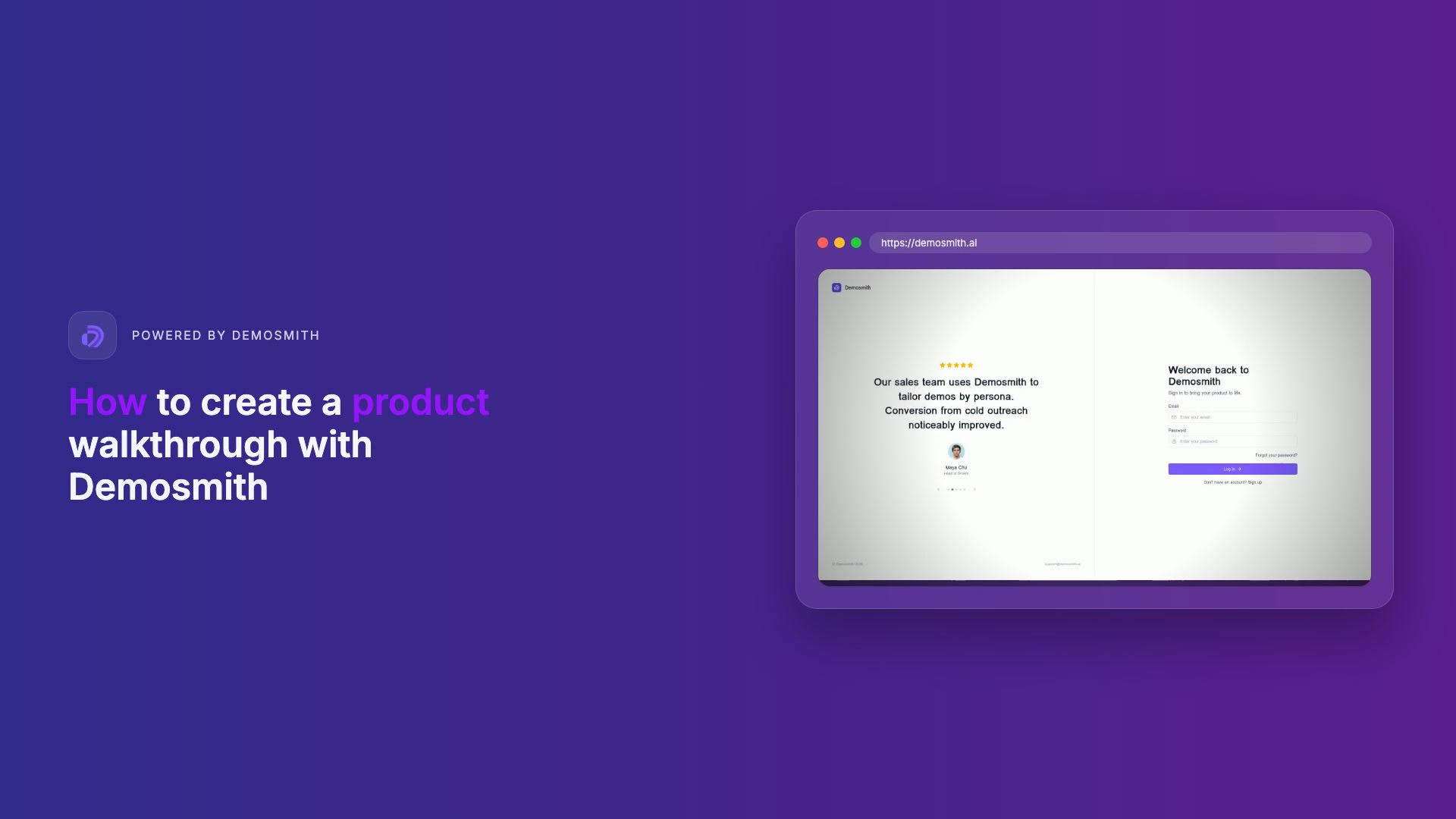
The output is a real MP4 plus a shareable link, which is the whole point of the switch from Karumi. The video works on YouTube, in sales emails, on your pricing page, inside decks, and on booth screens. It works for the prospect who never books a call and the champion who needs to sell internally. If you want the background on this category, our guide to AI demo agents covers the recorded and live approaches side by side.
The same run also produces more than video. Docusmith reads the finished walkthrough and exports it as Markdown, HTML, plain text, or PDF in one click, ready for your docs site, your help centre, or a PDF leave-behind after a sales call. The captured flow can also be published as an interactive demo for visitors who prefer clicking through. A Karumi session ends with a transcript. A Demosmith run ends with a video, an interactive demo, and a document.
Where Demosmith beats Karumi:
- Video output. Every demo is an MP4 file and a shareable link. Karumi demos evaporate when the call ends; Demosmith demos are permanent assets you can distribute everywhere.
- Documentation from the same run. Docusmith exports the finished walkthrough as Markdown, HTML, plain text, or PDF, ready for docs sites, help centres, and PDF leave-behinds. Karumi logs a transcript to your CRM and nothing more.
- Interactive output too. The captured flow can also be published as an interactive demo, so website visitors who prefer clicking through get their format from the same source, without a separate interactive tool in the stack.
- 29 languages included. Karumi's $900 plan covers one language. Demosmith generates voiceover in 29 languages on its standard plans, from $40 per month.
- Scripted, reviewable narration. The voiceover follows the script you approve. No improvised claims about your product, no mid-sentence cutoffs, no hallucination risk in front of a buyer.
- 22x lower entry price. Starter is $40 per month versus $900, with a free trial and no credit card required.
- Low maintenance. Your product is the source of truth. When the UI changes, rerun the prompt and the demo regenerates in minutes. No objection playbooks to maintain.
- Async by default. The buyer watches on their schedule, on any device, with nothing to attend. Teams that need to create SaaS demo videos without recording anything start here.
Pricing: Free trial, no credit card. Starter at $40/mo, Pro at $99/mo, Business at $250/mo, Enterprise custom.
Limitations:
- Demosmith produces video, not live conversations. A prospect who wants to ask questions in real time needs a live channel, whether that is Karumi, Naoma, or a human rep.
- Complex flows behind third-party authentication may need a second generation pass or extra guidance.
- Frame-by-frame editing control is narrower than a dedicated video editor, though auto-editing handles demo use cases well.
Best for: Teams that need demo videos for marketing, sales outreach, and enablement, especially across multiple languages and markets. The strongest fit is a company whose buyers research asynchronously and whose channels run on video.
The AI demo video generator category page covers the recorded side of this category.
Karumi sells one agent that talks to one prospect at a time, in one language, for $900 a month. Demosmith records your product once per flow and ships a video that talks to every prospect, in 29 languages, forever, from $40.
2. Naoma -- Live avatar demos at a friendlier price
Naoma is the closest thing to Karumi in this list. A video demo agent with a human-like or mascot avatar navigates your real product in a browser and presents it to each prospect on demand. Where Karumi's agent joins an open video call, Naoma's avatar-led sessions feel closer to a personalized walkthrough video that prospects can start themselves.
Pricing is where Naoma separates itself: Starter at $249 per month and Growth at $750 per month, both billed annually, with a Scale tier above them. That undercuts Karumi's $900 entry point while staying in the same live-agent territory, and Naoma prices per engaged demo rather than per seat.
Pricing: Starter at $249/mo, Growth at $750/mo, billed annually. Scale above.
Where Naoma beats Karumi:
- Entry price roughly a third of Karumi's, with usage-based scaling per engaged demo.
- Avatar-led format that reads as a personalized video demo rather than a rep-less sales call.
- Same core benefit: on-demand demos of your real product, no rep scheduling.
Limitations:
- Still a session-based product, not an MP4 generator. Distribution beyond the demo link is limited.
- Live narration carries the same consistency risks as Karumi, avatar or not.
- Annual billing on the published tiers; no free plan.
Best for: Teams that like the live-agent model but cannot justify $900 a month for it.
3. Consensus -- Enterprise demo automation with live agents in beta
Consensus is the incumbent option in this comparison, an enterprise demo automation platform that has now absorbed Saleo's live-demo data layer and is rolling out its own demo agents. Where Karumi is a seed-stage bet, Consensus is a mature platform with a G2 category badge, deep CRM integrations, and a full interactive demo product around its agent features.
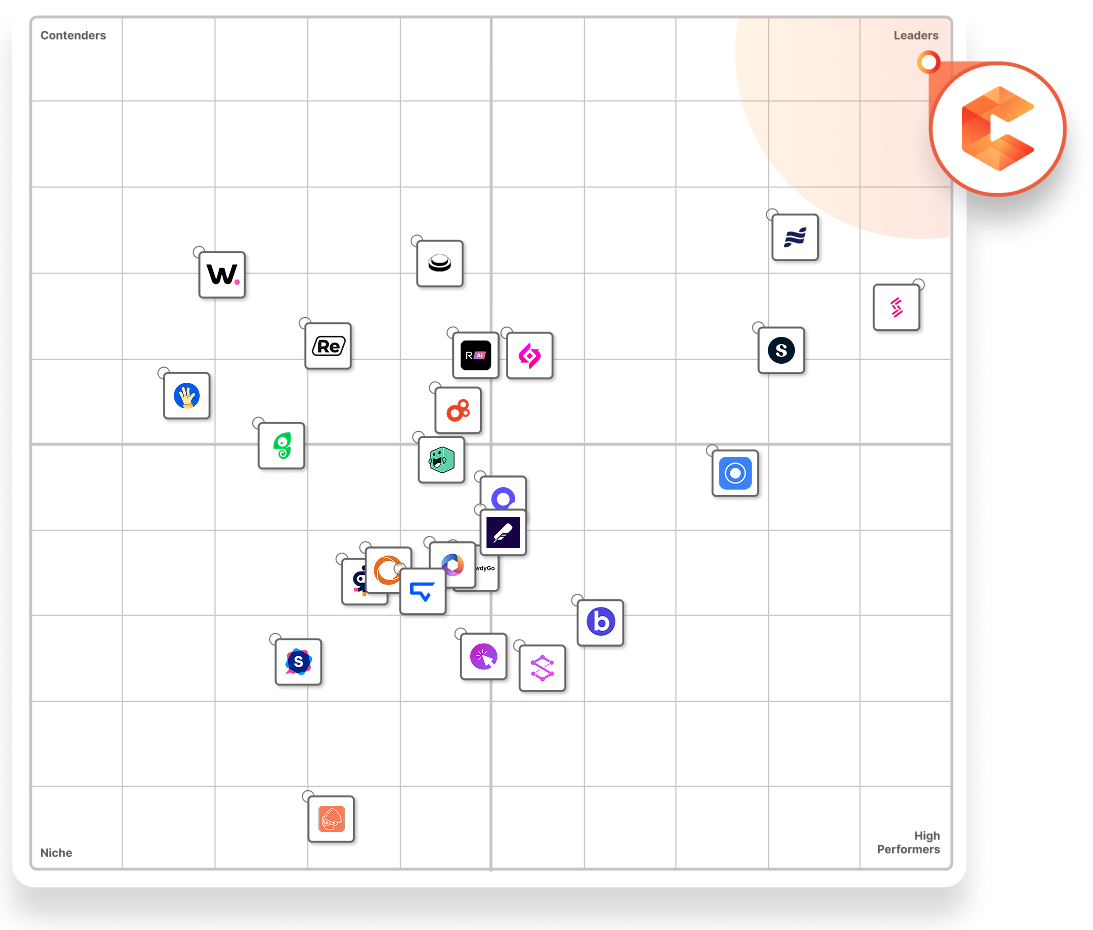
Pricing is quote-based; Consensus does not publish plan prices on its site. Entry-level contracts have historically started around $600 per month, and the platform sells per-user licenses with optional usage-based add-ons, so costs climb with team size.
Pricing: Quote-based. Reported entry around $600/mo; per-user licensing with usage add-ons.
Where Consensus beats Karumi:
- A mature interactive demo platform around the agents, not agents alone.
- Saleo-derived live-demo data layer for realistic demo environments.
- Enterprise track record, integrations, and support that a seed-stage startup cannot match.
Limitations:
- Agent capabilities are newer and partly in beta.
- No published pricing; procurement takes longer than a self-serve card entry.
- Interactive-first output. Not a video generator.
Best for: Enterprise teams that want demo agents, interactive demos, and demo environments from one vendor. See our full Consensus review and the Demosmith vs Consensus comparison for the details.
4. Navattic -- Interactive tours plus agent demos in beta
Navattic built its name on interactive HTML demo tours, and it is now adding its own "Agent Demos" layer that guides prospects inside a demo environment using screen control, the same architecture category as Karumi. For teams already running Navattic tours, the agent feature is a natural extension rather than a new purchase.
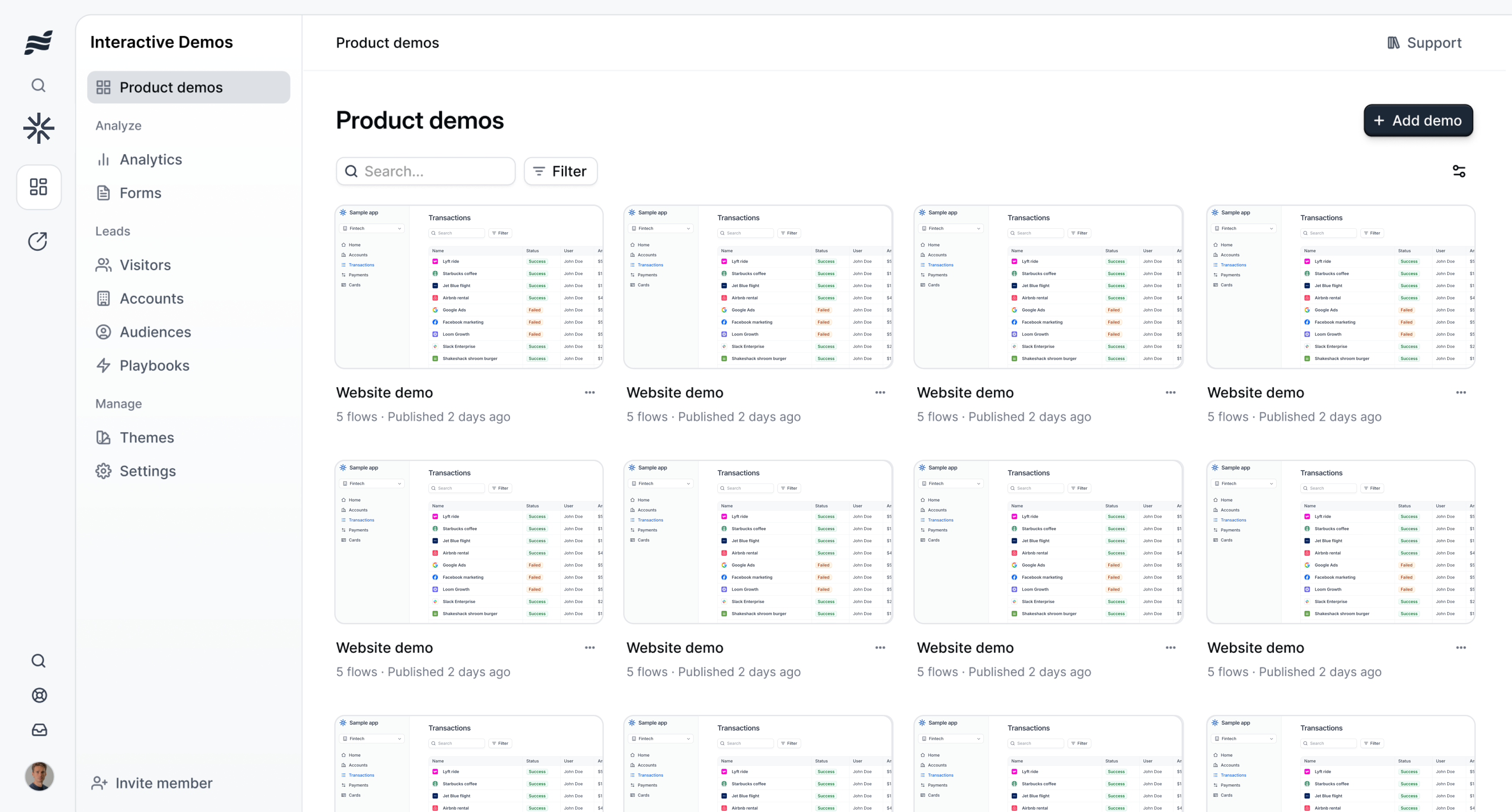
Navattic offers a free Starter plan with one seat and one demo. Paid plans (Base, Growth, Enterprise) are quote-based; the last published figures put Base around $500 per month, billed annually. Agent pricing is not yet published separately.
Pricing: Free Starter tier. Paid plans quote-based; Base last reported around $500/mo, billed annually.
Where Navattic beats Karumi:
- A free tier to evaluate the capture quality before any spend.
- A proven interactive demo product with analytics and CRM integrations.
- Agent demos inside the same platform as your tours, when the beta matures.
Limitations:
- Agent demos are in beta; feature depth is unproven next to Karumi's focus.
- Interactive-first. No video export with voiceover.
- Annual contracts and sales-led pricing on paid tiers.
Best for: Teams already invested in interactive tours that want to trial agent demos without a new vendor. Our Navattic review covers the platform in depth.
5. Arcade -- Interactive demos with AI, at a low entry price
Arcade is the cheapest way into interactive demos in this comparison. It pairs Chrome extension capture with AI features for generating demos and annotations, plus branching paths for persona-specific experiences, and it keeps a functional free plan.
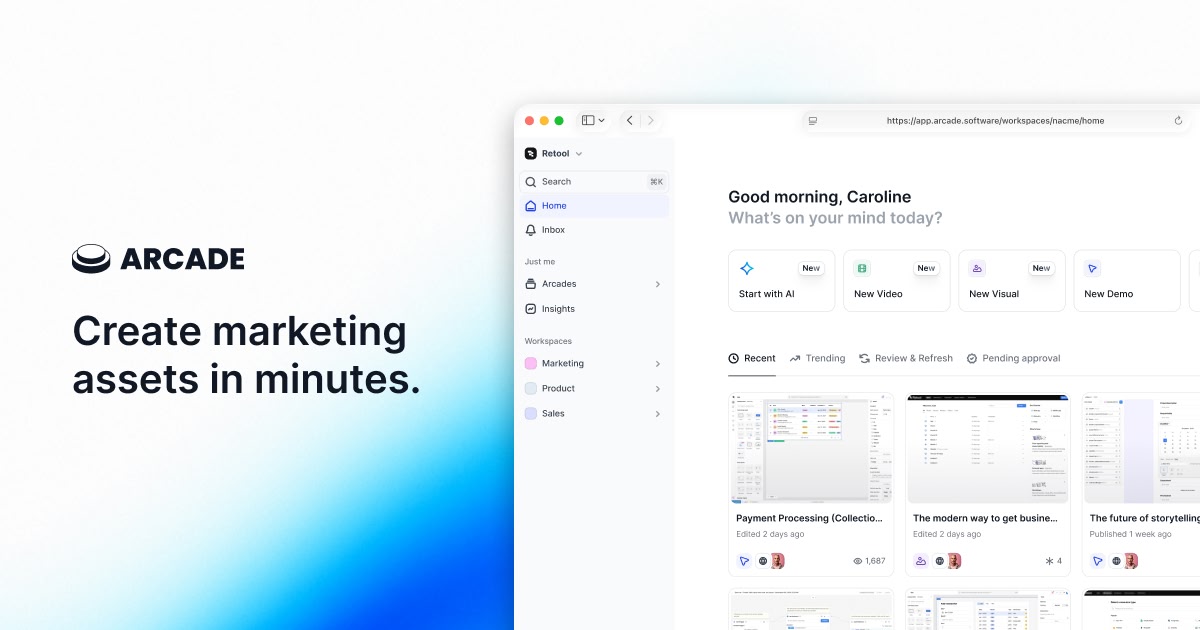
Pricing: Free plan available. Growth at $50/mo, or $42.50/mo billed annually. Team and Enterprise above.
Where Arcade beats Karumi:
- Free plan and a $50 entry point versus $900 with no free tier.
- Interactive demos that persist as on-demand assets, closer to video's async benefit.
- Established product with a large user base.
Limitations:
- Interactive output, not video. No MP4 export with voiceover.
- Manual capture via Chrome extension for each demo.
- No live-agent conversations.
Best for: Budget-conscious teams that want self-serve interactive demos today. Our Arcade review has the full breakdown.
Karumi vs Alternatives: Live Agent vs Recorded Video Demos
Live agents and recorded videos solve different problems, and most teams eventually need both. We covered the general trade-off in our comparison of interactive and video demos; the live-agent version of that choice has its own dynamics.
When a live agent wins
A live AI agent is unbeatable for the high-intent moment: an inbound prospect on your site right now, evaluating options, with questions only a conversation can answer. The agent qualifies, handles objections on the spot, and logs everything to the CRM. If your funnel's bottleneck is "too many prospects, too few reps," a live agent attacks that bottleneck directly, and Karumi's implementation of it is among the best-reviewed in the category.
When recorded video wins
Recorded video wins everywhere the viewer is passive or absent: YouTube and video SEO, LinkedIn posts, outbound email, sales decks, booth screens, paid ads, help centres, and internal enablement. It also wins on consistency, since the narration is scripted and identical for every viewer, and on economics, since one video serves unlimited prospects. A live agent produces none of these assets, at any price.
The practical approach: run each for its strength
The teams getting this right pair the formats. A live agent or rep handles the conversations; a video generator handles the library. Cost-wise, Demosmith Starter at $40 per month plus Naoma Starter at $249 per month still lands under Karumi's $900 Self-Serve plan alone, and covers asynchronous video and live-avatar demos rather than one agent in one language. If live conversations are not yet a bottleneck, start with video and add the live layer when inbound volume demands it.
Karumi vs Alternatives: Side-by-Side Comparison
Here is how Karumi stacks up against the alternatives across the dimensions that matter:
| Feature | Karumi | Demosmith | Naoma | Consensus | Navattic |
|---|---|---|---|---|---|
| Primary Output | Live AI-agent demo calls | MP4 video, interactive demo, docs | Avatar-led demo sessions | Interactive demos + agents | Interactive HTML tours |
| Video Export | No, live sessions only | Yes, primary output | Session replays | No | No |
| Documentation Export | Transcript only | Yes, Docusmith (MD, HTML, PDF) | No | No | No |
| AI Voiceover | Live voice, 1 language | Yes, 29 languages | Live avatar voice | No | No |
| Autonomous Capture | Yes, live navigation | Yes, URL + prompt | Yes, agent navigates | Agents in beta | Agent demos in beta |
| Multi-Language | 1 on Self-Serve, Enterprise for more | 29 languages included | Multilingual sessions | Varies by plan | Manual translation |
| Free Plan or Trial | None advertised | Free trial, no credit card | None listed | No | Free Starter tier |
| Starting Price | $900/mo (Self-Serve) | $40/mo (Starter) | $249/mo (Starter, annual) | ~$600/mo reported, quote-based | Free tier; paid quote-based |
| Best For | Live 24/7 demo conversations | Recorded demo videos at scale | Budget live avatar demos | Enterprise demo programmes | Interactive product tours |
Conclusion: Choosing the Right Karumi Alternative
Karumi is a serious product. The live-agent idea is the right answer for a real problem: buyers who want to see your product now, not after three rounds of scheduling. The voice quality is good, the security posture is enterprise-grade from the start, and the team ships fast. If your funnel needs live demo coverage around the clock, evaluate Karumi on its own merits; for a deeper look at where it sits in the category, see our demo automation tools comparison for 2026.
But a live call is not a video. If your team needs demo assets, MP4s that live on YouTube, in emails, on your site, and in decks, Karumi does not make them, and its $900 per month, one agent, one language entry point prices out the market that needs those assets most.
Demosmith is the alternative that keeps the autonomy and drops the live constraint. The AI agent navigates your real product from a URL and a prompt, and returns a polished, narrated MP4 in under 10 minutes, in 29 languages, from $40 per month, with a free trial and no credit card. A one-click Docusmith export turns the same run into the Markdown, HTML, or PDF document that goes with the video.
Naoma is the pick if you want the live-agent experience for less. Consensus and Navattic suit enterprise programmes and interactive-first strategies respectively. Arcade covers the budget interactive case. The overlap with Karumi across all four is smaller than it looks: only Demosmith produces the video output, and only Karumi produces the live conversation.
A live demo agent is a conversation. A demo video is an asset. Conversations end; assets compound. Buy the one your channels actually need.
Key Takeaways
- Karumi's AI agent runs live demo calls in your real product, 24/7, with CRM logging and an enterprise security posture. It is the strongest pure live-agent product in the category.
- Every Karumi demo is a live session. There is no MP4 export, no embed, and no leave-behind, so video channels go unserved.
- Karumi costs $900/mo for one agent, one language, and three seats. Extra languages require an Enterprise quote, and there is no advertised free plan.
- Demosmith is the strongest alternative for recorded output: autonomous capture from a URL, MP4 delivery in under 10 minutes, voiceover in 29 languages, from $40/mo with a free trial. Docusmith exports the same run as Markdown, HTML, or PDF documentation.
- Naoma ($249/mo) is the budget live-agent option. Consensus and Navattic add agent features to enterprise interactive platforms in beta. Arcade covers budget interactive demos from free.
- The strongest setup for most teams pairs formats: a live channel for high-intent conversations and a video generator for every channel where the buyer is passive. Together they can cost less than Karumi's entry plan alone.