What Is Navattic and Who Is It For?
Navattic sits at the top of the interactive demo platform market. With a 4.8 out of 5 rating on G2 across roughly 1,090 reviews, it holds the highest rating of any major platform in the category. The customer list reinforces that position: Dropbox, Ramp, Brex, Fivetran, PagerDuty, Citrix, DigitalOcean, Mixpanel, Wise, Front, and RingCentral all use Navattic to create product walkthroughs.
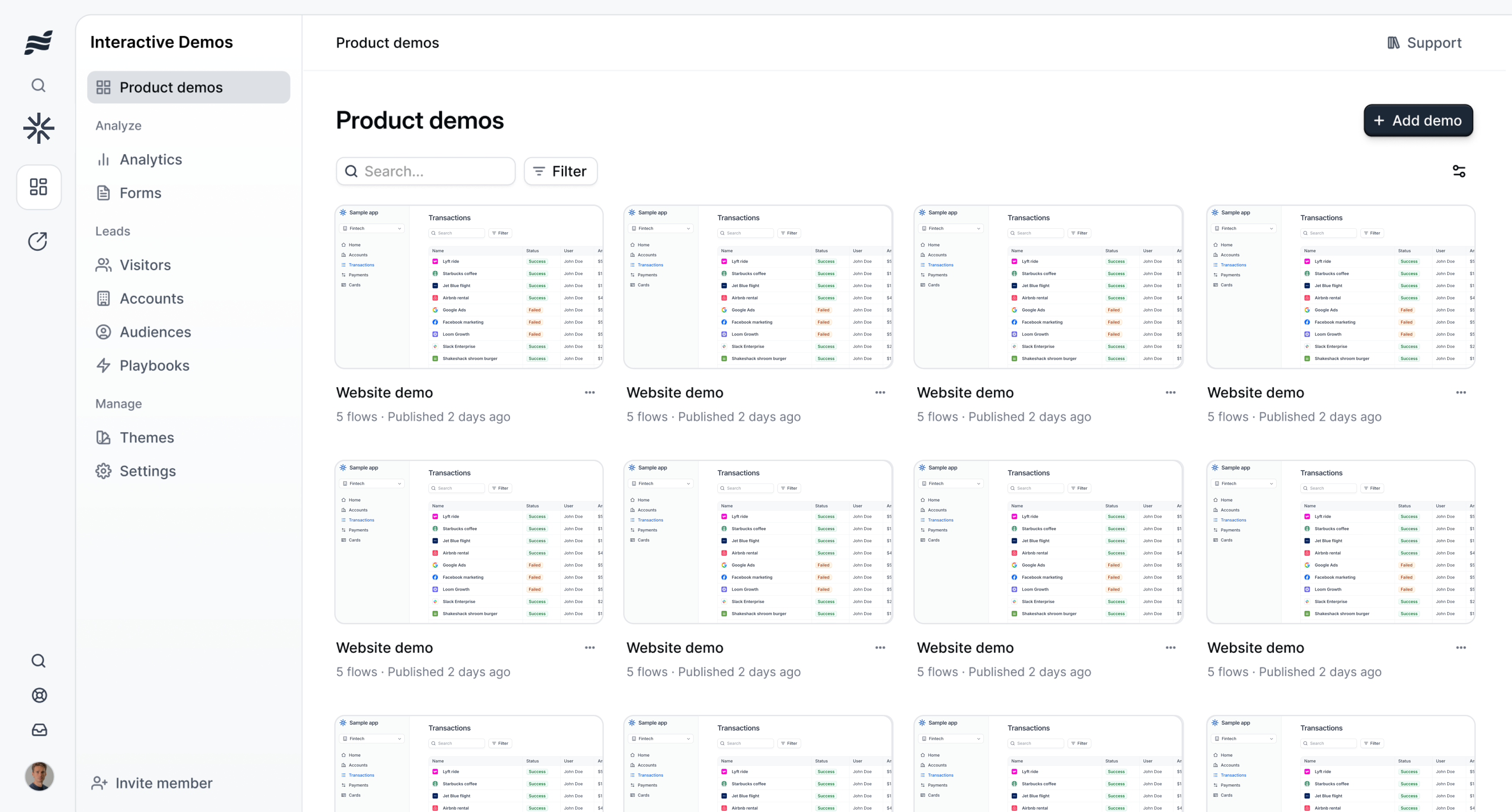
The core product lets you capture your application as an interactive HTML clone that prospects can click through in their browser. No video recording, no screenshots. Instead, Navattic recreates your product interface as a clickable simulation. Prospects type, scroll, and navigate as if they were using the real thing.
In 2026, Navattic expanded beyond static interactive demos. Agent Demos, their newest product, use an AI agent to run autonomous live demonstrations with prospects. Copilot, their AI assistant, can generate demos from prompts, review existing demos, and produce AI voiceover with avatars. Launchpad serves as a demo hub for organising content across teams. These additions push Navattic closer to a full demo automation platform.
The gap that remains is video. Navattic produces interactive HTML experiences. It does not export MP4 files. For teams that need video demos for email outreach, social media, or sales sequences, this is a meaningful limitation. You can embed Navattic demos in emails as links, but you cannot attach a demo video to a cold outreach email or post one on LinkedIn.
This review covers Navattic's features, pricing, strengths, weaknesses, and who it fits best. We tested the platform, analysed G2 reviews, and evaluated where Navattic excels and where other tools might serve you better.
Navattic Features Worth Knowing
Interactive Demos
This is the foundation. You capture your product using Navattic's Chrome extension, which clones the HTML and CSS of each screen. The result is an interactive walkthrough that preserves the look and feel of your actual product. Viewers click through steps, type into form fields, and navigate menus. The experience feels closer to a product trial than a demo video.
The capture quality is strong. Navattic handles dynamic UI elements, dropdowns, and multi-step flows better than screenshot-based tools. G2 reviewers consistently praise the realism of the interactive output. Teams at companies like Wise and Front use these demos in sales cycles where letting a prospect experience the product matters more than showing them a recording.
Agent Demos (New in 2026)
Agent Demos represent Navattic's most ambitious product expansion. Instead of a static interactive walkthrough, an AI agent navigates your product live with a prospect, answering questions and adjusting the demonstration based on what the prospect asks about. Think of it as a sales engineer that never sleeps.
The concept is compelling, but Agent Demos are new. Early feedback suggests the AI agent handles standard feature walkthroughs well but can struggle with edge-case questions or complex product flows. For teams with straightforward products, Agent Demos could reduce the need for live sales calls. For teams with complex or highly technical products, the agent is more of a conversation starter than a replacement for a human demo engineer.
Launchpad
Launchpad is Navattic's demo hub product. It gives you a centralised, branded page where prospects and customers can browse your entire demo library. Instead of sending individual demo links, you share one URL that lets people find the demo relevant to their role or use case.
For teams with five or more demos covering different features or verticals, Launchpad solves a real organisational problem. G2 reviewers mention that it reduced the time sales reps spent hunting for the right demo to send. It also gives marketing teams a single destination to promote in campaigns.
Copilot AI
Navattic's Copilot layer includes several AI features. Copilot Generate creates demo drafts from a text description. Copilot Prompt lets you instruct the AI to modify an existing demo. Copilot Review analyses your demo and suggests improvements to flow, messaging, and engagement. AI voiceover adds narration to interactive demos. AI avatars and avatar cloning let you add a presenter face to walkthroughs.
The AI voiceover and avatar features are well-executed. Navattic uses high-quality voice synthesis that sounds natural, and the avatars sync convincingly with the narration. Copilot Generate is useful for producing first drafts quickly, though most teams will refine the output before publishing.
Analytics and Heatmaps
Navattic provides engagement analytics that go deeper than most competitors. Heatmaps show where viewers click and which elements draw attention. Step-level tracking shows completion rates for each screen. Account identification ties demo engagement back to specific companies, even when viewers have not filled out a form.
This is where Navattic differentiates for sales teams. Knowing that a prospect from a target account spent eight minutes on your demo and dropped off at the pricing screen is actionable intelligence. Navattic feeds this data into Salesforce and HubSpot, so sales reps can prioritise follow-ups based on actual engagement rather than guesswork.
Integrations
Navattic supports 25-plus integrations. Salesforce and HubSpot are the most critical for sales teams, syncing demo engagement data directly into CRM records. Marketo, Outreach, and Salesloft connections support automated demo distribution in sequences. Slack notifications alert reps when high-value accounts engage with demos. Webhook support lets engineering teams pipe demo data into custom workflows.
Navattic also released Navattic MCP, which connects the platform to AI tools like Claude, Cursor, and ChatGPT. This lets you generate and manage demos from within your existing AI workflows rather than switching to the Navattic interface.
Security and Compliance
For enterprise teams, Navattic supports SSO, SCIM provisioning, and role-based access controls. The platform is SOC 2 Type II certified. These are table-stakes requirements for large organisations, and Navattic meets them. The Enterprise plan also includes offline demos, which let field teams run interactive demos without an internet connection during in-person meetings.
Navattic Pricing in 2026
Navattic's pricing structure changed recently. Monthly prices were removed from the website, replaced with "Billed annually" labels. The Starter tier is free, but paid plans now require a conversation with sales to get exact figures. Based on the last publicly available information, here is the current structure.
| Plan | Price | Key Features |
|---|---|---|
| Starter | Free | 1 seat, 1 demo, basic analytics, Navattic branding |
| Base | Billed annually | Multiple seats and demos, custom branding, CRM integrations, voiceover |
| Growth | Billed annually | Agent Demos, Launchpad, advanced analytics, A/B testing, personalisation variables |
| Enterprise | Custom | SSO, SCIM, offline demos, dedicated CSM, SLA, custom integrations |
The free Starter plan is genuinely useful for testing Navattic. You get one demo with full interactive capture, which is enough to evaluate the product quality before committing. That said, the single-demo limit is tight for any real workflow.
Navattic's historical pricing had Base at roughly $500 per month and Growth at roughly $1,200 per month. The shift to opaque "Billed annually" pricing makes direct comparison difficult. Teams evaluating Navattic should request a quote early in the process to avoid wasting time on a tool that falls outside budget.
Compared to competitors, Navattic sits at the premium end of the market. Storylane and Supademo offer comparable core functionality at lower price points. What you pay for with Navattic is the depth of analytics, the quality of the interactive capture, and the maturity of the CRM integrations.
What Users Like About Navattic
- Exceptional G2 ratings. A 4.8 out of 5 across roughly 1,090 reviews is unusually strong. Reviewers consistently highlight the quality of the interactive capture, the ease of creating demos, and the responsiveness of the Navattic support team. Few products in the category have this level of user validation.
- Interactive capture quality is the best in class. Navattic clones your product interface more faithfully than any competitor. Dynamic UI, dropdowns, and multi-step forms all reproduce with high fidelity. G2 reviewers repeatedly mention that prospects cannot tell the difference between a Navattic demo and the real product.
- Deep CRM and analytics integration. Account-level identification, heatmap data, and engagement metrics flowing into Salesforce and HubSpot give sales teams concrete signals for follow-up. This is Navattic's clearest differentiator for revenue teams.
- Strong customer base and social proof. When Dropbox, Ramp, Brex, and Wise all use the same demo tool, it signals product maturity. For buyers evaluating options, this customer list carries weight in internal procurement discussions.
- Free Starter plan for evaluation. Being able to create a full interactive demo at no cost lets teams test the capture quality and viewer experience before committing budget. This lowers the barrier for teams that are new to interactive demos.
- Copilot AI features accelerate creation. Copilot Generate produces usable first drafts. AI voiceover adds narration without hiring a voice actor. These features save time, particularly for teams building multiple demos across product lines.
What Users Complain About
- No video output. Navattic produces interactive HTML demos. If your team needs MP4 video for email sequences, social media posts, or sales enablement decks, Navattic cannot deliver that format. You would need a separate tool for video demo creation. For teams that run video-heavy outbound campaigns, this is a significant gap.
- Manual capture and maintenance. Navattic requires someone to click through the product and capture each demo. When your product UI changes, demos need to be re-captured. For teams with large demo libraries across frequent releases, this maintenance burden adds up. Competitors like Arcade have introduced auto-updating features to address this problem.
- Pricing transparency has decreased. Navattic removed monthly pricing from its website. Teams now need to contact sales for exact figures. This friction frustrates buyers who want to compare options quickly, especially smaller teams that want to self-serve without a sales conversation.
- Agent Demos are new and unproven. The AI agent that runs live demos is an exciting concept, but it is a first-generation product. Early users report that the agent handles standard flows well but falters with complex or technical questions. Teams should evaluate Agent Demos with a test scenario before relying on them for customer-facing presentations.
- Interactive demos require active viewer participation. Unlike a video that a prospect can watch passively, interactive demos require the viewer to click through each step. In cold outreach contexts where you have seconds of attention, the friction of "click to start, then keep clicking" can reduce engagement compared to hitting play on a video.
- Offline demos require Enterprise plan. Field sales teams that present in person without reliable internet access need offline demos. Navattic locks this capability behind the Enterprise tier, which puts it out of reach for mid-market teams that have this requirement.
Who Should Use Navattic
Navattic is the right tool for mid-market and enterprise sales teams that want to connect demo engagement directly to pipeline activity. If your sales reps use Salesforce or HubSpot and you want demo data flowing into your existing revenue workflows, Navattic's CRM integrations and account-level analytics are the strongest in the category.
It also fits marketing teams at SaaS companies with products that benefit from hands-on exploration. If your product has a distinctive interface or workflow that prospects need to experience rather than just see, Navattic's interactive capture creates a more compelling first impression than a screenshot-based tool or a video.
Navattic is harder to recommend for teams that need video output. If your sales motion relies on sending demo videos in cold emails, posting product demos on social media, or embedding demo content in slide decks, Navattic does not produce that format. You would need to pair it with a video demo tool, which adds cost and complexity.
Small teams and startups should also consider whether Navattic's pricing fits. The free Starter plan is useful for evaluation, but moving to a paid plan requires a sales conversation and a budget that matches premium-tier pricing. Teams that want to self-serve at a lower price point may find better fits elsewhere.
Navattic Alternatives to Consider
If Navattic does not fit your format requirements or budget, these tools take different approaches to demo creation.
Demosmith is an AI Demo Agent that generates video demos autonomously. You paste a product URL and write a short prompt describing what to demonstrate. Demosmith launches a cloud browser, navigates your product, records the screen with cursor tracking, and produces a finished MP4 video with voiceover, captions, transitions, and branding. No manual capture, no clicking through screens, no editing. The finished video is ready in roughly 10 minutes. AI voiceover supports 29 languages for international teams. Pricing starts at $40 per month on the Starter plan, with a free trial and no credit card required. If you need video output rather than interactive HTML, this product demo video generator and strongest alternative to Navattic covers the gap, and you can browse real SaaS demo video examples to see the finished output first. Its limitations: interactive demos (added September 2026, compiled from the same recordings) are guided walkthroughs rather than Navattic-style HTML captures, and complex authentication flows may need additional guidance in your prompt.
The two tools take different shapes. Navattic embeds an interactive tour a prospect clicks through on your site. Demosmith produces a finished video you can send or embed anywhere. Here is how they line up.
| Capability | Navattic | Demosmith |
|---|---|---|
| Primary output | Interactive HTML product clone | Narrated MP4 + interactive demos |
| How the demo is built | Capture your UI into an interactive tour | AI agent navigates from a URL and prompt |
| Video output | No video | Finished MP4 video |
| AI voiceover and captions | Not the focus | Built in, 29 languages |
| Autonomous capture | Manual capture | Fully autonomous |
| Starting price | Free; paid from ~$500/mo | $40/mo |
| Best for | Embedded interactive tours for PLG | Demo videos for sales, onboarding, launches |
Storylane competes directly with Navattic in the interactive demo space. It offers HTML capture, demo hubs, and CRM integrations at lower price points. Storylane's customisation options are more flexible than Navattic's in some areas, and its pricing is more transparent. For teams that want Navattic-quality interactive demos without Navattic-tier pricing, Storylane is the closest alternative. See our Navattic vs Storylane vs Arcade comparison for a detailed breakdown.
Walnut focuses on sales-led demo workflows. It offers interactive product demos with a strong emphasis on demo automation and personalisation for enterprise sales teams. Walnut's data injection capabilities let you populate demos with prospect-specific data, creating tailored experiences without manual setup. For large sales organisations that need personalised demos at scale, Walnut is worth evaluating.
Arcade produces the most visually polished interactive demos in the category. Its cursor animations, background treatments, and branded styling create demos that look cinematic. Arcade also added Creator Studio in 2026, which generates video content from demo recordings. For marketing teams that prioritise visual quality above all else, Arcade delivers the best-looking output.
Our Verdict
Navattic has earned its position at the top of the interactive demo market. The capture quality is the best we have tested. The CRM integrations and account-level analytics are the deepest in the category. The G2 rating of 4.8 across roughly 1,090 reviews reflects a product that consistently delivers for its target customer. The 2026 additions of Agent Demos and Copilot AI show Navattic investing in automation, which is the right direction.
The limitations are real. No video output means Navattic cannot serve teams that need MP4 demos for video-centric workflows. Manual capture and maintenance creates ongoing work, especially for teams with large demo libraries. Pricing that requires a sales conversation adds friction for smaller teams that want to move fast.
Navattic is the market leader in interactive demos for good reason. Whether it is the right tool for your team depends on whether your demos need to be interactive HTML that prospects click through, or video that prospects watch. If you need the latter, Navattic cannot help you.
Key Takeaways
- Navattic has the strongest interactive demo capture quality in the market. The HTML clone fidelity is high enough that prospects often cannot distinguish it from the real product.
- CRM integrations and account-level analytics set Navattic apart for revenue teams. Demo engagement data flowing into Salesforce and HubSpot drives better pipeline prioritisation.
- Agent Demos are an ambitious new product that could reduce the need for live sales calls, but the feature is early and should be tested with your specific product before relying on it in customer conversations.
- Navattic does not produce video output. Teams that need MP4 demos for email outreach, social media, or sales enablement will need a separate tool like Demosmith for video creation.
- Pricing transparency has decreased. The removal of monthly prices from the website means teams must contact sales for exact figures, which adds friction to the evaluation process.
- The free Starter plan is a genuine opportunity to test Navattic's capture quality with a real product before committing budget. Use it to validate that the interactive format works for your audience.
Disclosure: Demosmith is our product. We have done our best to present Navattic fairly and accurately based on public information, user reviews, and our own evaluation.